Godex
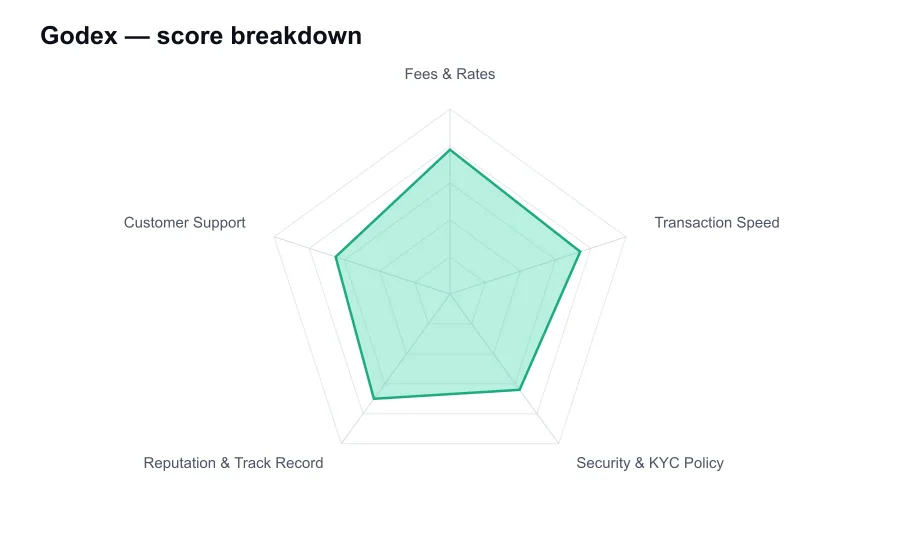
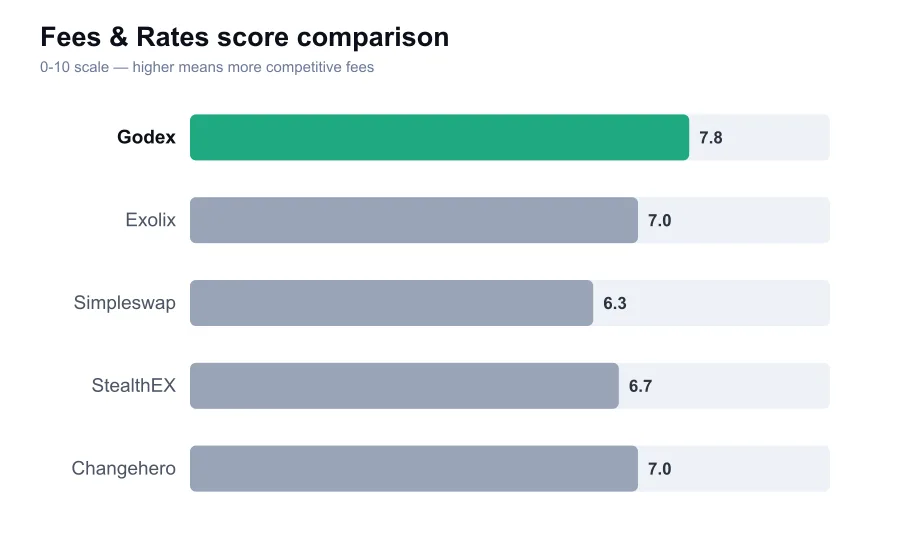
Godex scores 7.1/10 overall in our independent review, measured against every other provider we've compared, strongest on Fees & Rates (7.8/10) and weakest on Security & KYC Policy (6.4/10).
Status: active (checked 2026-10-13T18:34:43.085Z)
Editorial independence: our scores and rankings are produced using the fixed criteria above and are not influenced by advertisers. This is an independent ranking site and is not operated by, or affiliated with, any provider we list.
Affiliate disclosure: some links on this page may earn us a commission at no extra cost to you. This does not affect our rankings.
| Best for | Advertised 0.5% fixed fee, Fixed-rate quote model, No routine registration, Broad crypto pair selection |
|---|---|
| Not for | Effective spreads vary by pair, Limited corporate transparency, Large swaps still carry intermediary risk |
What is Godex?
Score Breakdown
| Criterion | Score | Note |
|---|---|---|
| Fees & Rates | 7.8 | Advertised 0.5% fixed service fee |
| Transaction Speed | 7.4 | Prompt processing after chain confirmations |
| Security & KYC Policy | 6.4 | No-account flow, but intermediary trust remains |
| Reputation & Track Record | 7.0 | Long-running service with a decent public record |
| Customer Support | 6.5 | Useful order help, limited formal recourse |
| Fact | Value | Source |
|---|---|---|
| Advertised exchange fee | 0.5% | - |
| Rate model | Fixed-rate exchanges | - |
| Account registration | Not routinely required | - |
| Maximum exchange limit | No stated maximum | - |
| Service type | Crypto-to-crypto instant exchange | - |
Our Review
Godex is a long-running instant crypto exchange that sells privacy and simplicity rather than advanced trading tools. There is no conventional account dashboard, no order book to learn, and no request to deposit money into a standing exchange balance. Choose a pair, give a receiving address, send crypto, and wait for the output. That model still has a place, especially for users who value a quick one-off conversion.
Its strongest commercial argument is easy to understand. Godex has traditionally advertised a fixed 0.5% service fee and fixed exchange rates for its transactions. For users burned by a quote that changes between clicking exchange and receiving funds, a fixed-rate approach is reassuring. The catch is that a fixed quote is only as attractive as the spread built into it, so the visible fee should not be the only comparison point.
Godex's prices are usually reasonable for a convenience exchanger, but they are not automatically the cheapest route. A liquid pair such as BTC to ETH can often be traded more cheaply through a major exchange if a user is willing to complete account verification and place an order. Godex is charging for the shortcut. It also depends on external liquidity, which means thin altcoin pairs can carry a wider effective spread than its 0.5% branding suggests.
The fixed-rate model is useful if a recipient needs a precise amount. It is less magical than some marketing implies. The user must send the correct amount, use the correct network, and send it before the order's timing conditions expire. If the deposit is late or partial, the transaction may need manual handling. That is true of every instant exchanger, but it is particularly important with a service built around quote certainty.
Speed is solid under normal conditions. Godex begins after the required deposit confirmations, sources the output, and broadcasts the payout. Fast chains can feel quick, while a Bitcoin deposit can take from tens of minutes to longer depending on confirmation requirements and fee conditions. The service cannot make a congested blockchain faster, and customers should be suspicious of any exchanger that claims otherwise.
A useful practical feature is that Godex has offered a broad selection of assets without making the interface feel cluttered. It has long listed many established coins and less common altcoins, which can save users from making two separate swaps. Still, asset availability is not permanent. A token can disappear from an aggregator's inventory or be temporarily unavailable, and users should inspect the exact network shown on the order page.
Godex operates without routine KYC or account registration, which is central to its appeal. That should not be confused with a promise that no transaction will ever be reviewed. Its terms reserve compliance and anti-money-laundering controls, as they should. If an order is flagged, the customer may be asked for information and the speedy no-account experience becomes a slower support case.
Security here is more about operational discipline than account protections. Because there is no account, users do not have a password or 2FA profile to protect at Godex. They do, however, need to protect themselves from phishing, clipboard malware, and fake support accounts. The service receives the input funds before sending the output, so a customer must trust its systems and liquidity partners for the duration of the transaction.
Godex has not attracted the same level of serious public controversy as FixedFloat, and that is meaningful. It has existed for years and has accumulated a substantial body of customer reviews, including plenty of ordinary complaints about delayed transactions that are normal in this category. Its reputation is decent, not elite. The company is less transparent than a regulated exchange about ownership, financial controls, and dispute procedures.
Customer support is available through its website channels and has generally been regarded as responsive for basic order-status problems. The quality of support needs to be judged differently from a retail bank. If a transaction is stuck because a blockchain is congested, support cannot force a confirmation. What it can do is identify the issue, explain the next step, and provide transaction hashes. Godex is adequate here, but its support operation is not a reason to choose it over competitors.
The absence of maximum transaction limits has been part of Godex's public pitch. I would treat that as a technical capability, not a recommendation to send a large amount. Bigger orders face more liquidity risk, more compliance scrutiny, and a greater cost if anything goes wrong. Splitting a substantial conversion into tested tranches is the more sensible approach.
Godex compares well with simple competitors such as ChangeNOW and SimpleSwap for users who want a clean no-login flow. It compares less favorably with a full exchange for repeat traders who can benefit from maker fees, limit orders, and stronger account-level controls. It is a tool for conversion, not a home for your portfolio.
The mobile experience is essentially web-first, and that is fine for checking an order but less ideal than a native app with strong device protections. The site is straightforward enough that a desktop browser is usually the safest place to use it. Taking a minute to verify the outgoing address and destination chain is more valuable than rushing through a swap on a phone.
My view is that Godex is one of the more credible no-account instant exchangers, chiefly because its product is uncomplicated and its fee policy is easy to grasp. It is still an intermediary with thin public corporate transparency, and that limits how much trust it deserves. Use it for modest, ordinary crypto conversions where speed and privacy are more important than extracting the last basis point of price. For large trades or regulated fiat access, look elsewhere.
Pros & Cons
| Pros | Cons |
|---|---|
| Advertised 0.5% fixed fee | - |
| Fixed-rate quote model | - |
| No routine registration | - |
| Broad crypto pair selection | - |
How Godex Works
- Choose the asset to send and the asset to receive
- Enter the amount and your destination wallet address
- Review the fixed quote and order details
- Send the stated amount to the generated deposit address
- Wait for confirmations and receive the payout
KYC
| Requirement | optional |
|---|---|
| Notes | Godex does not routinely require account registration or identity verification, but its terms allow AML-related checks and requests for information in flagged cases. |
Supported Assets
| Notable Coins | Bitcoin, Ethereum, Litecoin, Monero, Dogecoin, TRON, XRP |
|---|
Limits
| Max Transaction | No stated maximum |
|---|---|
| Notes | Minimum amounts vary by selected asset, network fee conditions, and available liquidity. |
How to Use Godex Safely
- Compare the final output with another live quote
- Confirm the exact token network before depositing
- Use a self-custody wallet if timing matters
- Save the order ID and transaction hashes
- Test large conversions with a small first order
FAQ
What fee does Godex advertise?
Godex has advertised a 0.5% exchange fee with fixed rates. The actual output can still reflect liquidity-provider pricing and blockchain network costs, so compare the final quote rather than the percentage alone.
Does Godex have a maximum exchange limit?
Godex has promoted no maximum exchange limit. That does not mean every large order will have the same liquidity, price, or review outcome, so substantial swaps should be tested in smaller tranches.
Are Godex rates fixed?
Godex is known for presenting fixed-rate exchanges. The quote depends on sending the stated amount to the generated address within the order conditions shown before payment.
Why is my Godex exchange taking longer than expected?
The common causes are required deposit confirmations, chain congestion, wallet maintenance, thin liquidity for the pair, or a deposit that does not match the order amount.
Can I exchange a less common altcoin on Godex?
Godex has historically listed a wide selection of cryptocurrencies, including smaller altcoins. Check that the exact coin and network remain available on the live pair selector before creating an order.
Should I send funds from an exchange to Godex?
You can, but withdrawal delays and exchange-side compliance checks can cause you to miss an order's deposit window. A self-custody wallet gives you more control over timing and transaction details.