LetsExchange
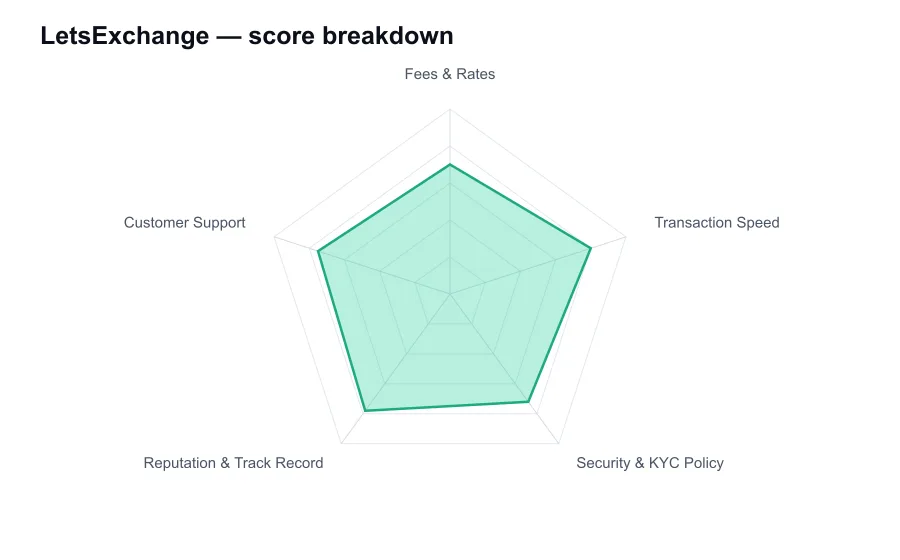
LetsExchange scores 7.5/10 overall in our independent review, measured against every other provider we've compared, strongest on Transaction Speed (8.0/10) and weakest on Fees & Rates (7.0/10).
Status: active (checked 2026-10-13T18:34:43.129Z)
Editorial independence: our scores and rankings are produced using the fixed criteria above and are not influenced by advertisers. This is an independent ranking site and is not operated by, or affiliated with, any provider we list.
Affiliate disclosure: some links on this page may earn us a commission at no extra cost to you. This does not affect our rankings.
| Best for | More than 5,000 promoted crypto assets, Fixed-rate and floating-rate routes, Wallet widget and API integrations, 24/7 support and transaction tracking |
|---|---|
| Not for | No universal flat fee to compare quickly, Final pricing can vary by liquidity route, AML review can interrupt a no-login swap |
What is LetsExchange?
Score Breakdown
| Criterion | Score | Note |
|---|---|---|
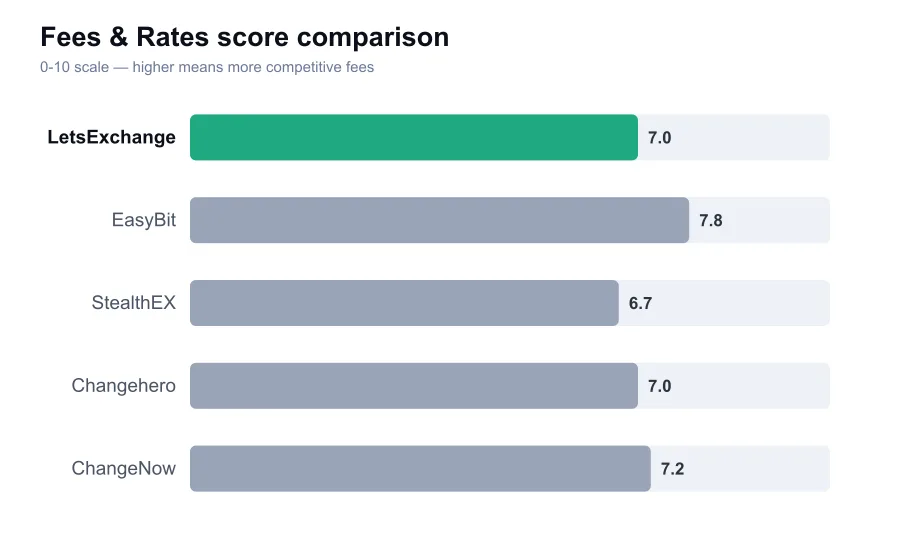
| Fees & Rates | 7.0 | Quote-based pricing, compare final outputs |
| Transaction Speed | 8.0 | Fast routing on liquid pairs and active chains |
| Security & KYC Policy | 7.2 | No standing balance, AML reviews still possible |
| Reputation & Track Record | 7.8 | Broad integrations and established public footprint |
| Customer Support | 7.5 | 24/7 assistance and order tracking |
| Fact | Value | Source |
|---|---|---|
| Promoted asset coverage | 5,000+ cryptocurrencies | - |
| Rate options | Fixed and floating | - |
| Service type | Instant exchange aggregator | - |
| Customer support | 24/7 | - |
| Integration products | API and exchange widget | - |
| Account registration | Not routinely required | - |
Our Review
LetsExchange is a crypto swap aggregator that aims to make a large number of assets and networks accessible through one simple exchange screen. It is more ambitious than the old-fashioned Bitcoin-to-altcoin instant exchanger. Alongside direct user swaps, it has positioned itself as an infrastructure provider, offering exchange widgets and APIs for wallets and other crypto products. That broader role gives it more visibility than many no-account competitors.
The service is built for convenience rather than active trading. You do not place bids on an order book or keep a trading balance. You select what you are sending, select what you want to receive, provide a receiving address, and send the deposit. LetsExchange then routes the trade through its liquidity sources and pays out the destination asset. It is an intermediary, not a decentralized exchange.
Its asset coverage is one of the real attractions. LetsExchange has publicly promoted support for more than 5,000 cryptocurrencies and a large range of blockchain networks. That headline should be read as available routes rather than a guarantee that every coin is liquid at every minute. Still, it makes the service unusually useful for wallet users who need to bridge from a niche token to a major asset without first opening an account at a centralized exchange.
Fees are less neat than Godex's flat 0.5% marketing. LetsExchange typically presents the final exchange rate rather than a universal service fee that applies to every trade. That is normal for an aggregator that draws from different liquidity venues, but it makes comparison shopping necessary. A user should open the exact same pair on LetsExchange and at least two alternatives, then compare the final destination amount after network costs.
The platform offers both fixed-rate and floating-rate options for many routes. Floating rates can produce a better estimate and are sensible for ordinary swaps where a minor move is acceptable. Fixed rates are more useful for users who need a known result, though availability depends on the pair and market conditions. Fixed does not mean that user errors disappear. Sending the wrong token, choosing the wrong chain, or missing the deposit window can still derail an order.
LetsExchange's exchange speed is usually good for a service handling so many possible paths. The platform can be very quick on fast chains and liquid pairs. Bitcoin and Ethereum swaps still depend on deposits receiving confirmations, and some token routes require multiple operational steps before payout. A quoted estimated time is just that, an estimate. Network congestion, a maintenance event, or liquidity re-routing can extend it.
The security proposition is mixed but reasonably mature for an instant exchanger. LetsExchange does not require users to leave a long-term custodial balance, which reduces exposure compared with keeping coins on a trading platform. Yet it takes temporary control of the funds during the swap. That is why the service's track record, support behavior, and compliance rules matter more than slick design.
Routine registration and KYC have not been central to its customer flow. A wallet address is generally enough to start an exchange. However, LetsExchange maintains AML procedures and can request information if a transaction is flagged. This is a standard caveat in the category, but it matters for users who assume that a no-login workflow guarantees immediate payout. It does not.
The company's public reputation is better than most pure instant-exchange sites. Its wallet integrations, API business, social presence, and sustained marketing have created a larger footprint. There are customer complaints, as there are with every service that processes irreversible transfers, but LetsExchange is not defined by a major public security scandal in the way FixedFloat is. I would call its reputation good rather than exceptional.
Support is one of its better areas. LetsExchange has promoted 24/7 customer assistance and offers order tracking, which is valuable when a user needs to distinguish a delayed blockchain confirmation from a real processing problem. The support team cannot reverse an already confirmed deposit to a wrong network, but responsive explanations and traceable ticket handling make a major difference. Its support still does not equal a regulated broker's formal complaint structure.
The API and widget offering deserves attention because it changes the risk picture slightly. If you encounter LetsExchange inside another wallet or website, make sure you know whether you are interacting with LetsExchange directly or with the host product's implementation. The quote, address generation, and support responsibilities can be split. For a large transaction, using the official website and retaining all order records is usually cleaner.
LetsExchange is especially practical for users who already hold crypto in self-custody and need a one-time cross-chain conversion. It can be less attractive for repeated traders. A verified account at Kraken, Coinbase, Binance, or another major exchange can often offer tighter pricing on liquid assets, even after withdrawal fees. The aggregator premium pays for access and simplicity, not for the best possible execution every time.
A careful user should treat network labels as seriously as coin tickers. USDT on Ethereum, Tron, BNB Smart Chain, Polygon, and Solana are not interchangeable deposits. LetsExchange may support several of these routes, but the generated deposit address applies only to the selected network. This is the most common preventable mistake in multi-chain swapping.
LetsExchange earns a positive recommendation for ordinary users, with conditions. It has strong asset breadth, useful fixed and floating options, and a more visible operating record than small anonymous swap sites. Its pricing is quote-driven, so it is never a service I would use without comparing the final amount. For medium-sized self-custody swaps, it is a competent choice. For large capital movements, use a test transaction and consider a venue where you control execution directly.
Pros & Cons
| Pros | Cons |
|---|---|
| More than 5,000 promoted crypto assets | - |
| Fixed-rate and floating-rate routes | - |
| Wallet widget and API integrations | - |
| 24/7 support and transaction tracking | - |
How LetsExchange Works
- Select the sending and receiving assets and networks
- Choose a fixed or floating rate where available
- Enter the receiving wallet address
- Review the final quote and generated deposit details
- Send the exact deposit amount on the selected network
- Track the order until the payout reaches your wallet
KYC
| Requirement | optional |
|---|---|
| Notes | LetsExchange generally supports no-login swaps, but AML procedures can trigger a request for information or a transaction review in flagged cases. |
Supported Assets
| Coins Supported | 5000 |
|---|---|
| Notable Coins | Bitcoin, Ethereum, Tether, USD Coin, Solana, BNB, TRON, XRP, Litecoin, Monero |
| Networks | Bitcoin, Ethereum, TRON, BNB Smart Chain, Polygon, Solana, Avalanche, Arbitrum |
How to Use LetsExchange Safely
- Compare the exact final output with competing quotes
- Select the correct token network before depositing
- Run a small test transaction for a new route
- Save the order ID and on-chain transaction hashes
- Use the official site rather than a copied widget link
- Do not send funds after a fixed-rate deposit window expires
FAQ
How many assets does LetsExchange support?
LetsExchange has promoted support for more than 5,000 cryptocurrencies. Availability varies by pair, network, liquidity conditions, and whether a fixed-rate route is currently offered.
Does LetsExchange charge one flat fee?
No universal flat fee applies to every route. LetsExchange generally shows a final quote based on the selected pair, liquidity route, and network costs, so compare the output amount directly.
What is the difference between fixed and floating rates?
A fixed-rate route is intended to preserve the quoted output if you send the correct amount within the stated conditions. A floating rate can move with the market while the deposit is confirming.
Can LetsExchange review or hold a transaction?
Yes. LetsExchange uses AML procedures and may request information for a flagged transaction. A no-login exchange flow does not guarantee that every swap will complete without compliance review.
Why does my LetsExchange order show as pending?
Pending status commonly means the deposit lacks enough blockchain confirmations, the network is congested, the selected route is being processed, or the deposit details need review.
Can I use LetsExchange inside a wallet app?
Yes, LetsExchange provides widget and API infrastructure used by crypto products. If you use an embedded version, retain the order ID and check whether the host wallet or LetsExchange handles support.
Can I send USDT on any network?
Only send USDT on the exact network selected for the order. Ethereum, Tron, BNB Smart Chain, Polygon, and Solana versions of USDT use different transaction routes and are not interchangeable.