Trocador
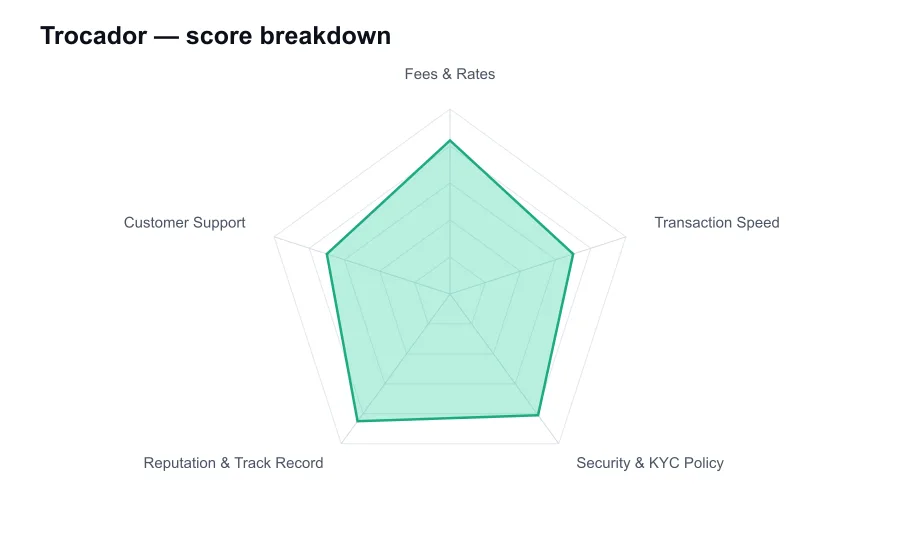
Trocador scores 7.9/10 overall in our independent review, measured against every other provider we've compared, strongest on Reputation & Track Record (8.5/10) and weakest on Customer Support (7.0/10).
Status: active (checked 2026-10-13T18:42:58.552Z)
Editorial independence: our scores and rankings are produced using the fixed criteria above and are not influenced by advertisers. This is an independent ranking site and is not operated by, or affiliated with, any provider we list.
Affiliate disclosure: some links on this page may earn us a commission at no extra cost to you. This does not affect our rankings.
| Best for | Compares offers from multiple exchange providers, Clear provider and privacy-oriented route information, No account required for ordinary swaps, Established since 2017, Useful fixed-rate and floating-rate route choices |
|---|---|
| Not for | Adds a 0.5% platform fee, Underlying providers can still request KYC, Trocador cannot directly control a partner-held transaction |
What is Trocador?
Score Breakdown
| Criterion | Score | Note |
|---|---|---|
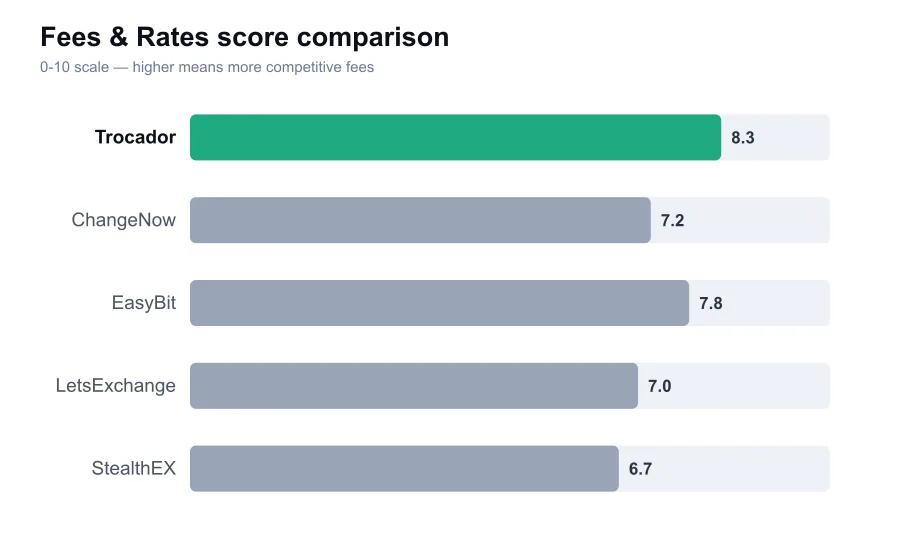
| Fees & Rates | 8.3 | 0.5% platform fee, offset by useful provider-rate comparison |
| Transaction Speed | 7.0 | Speed varies with the chosen provider and blockchain |
| Security & KYC Policy | 8.1 | Strong route transparency, though partners retain transaction control |
| Reputation & Track Record | 8.5 | Operating since 2017 with a strong privacy-community profile |
| Customer Support | 7.0 | Responsive mediation, but partners control many disputed swaps |
| Fact | Value | Source |
|---|---|---|
| Founded | 2017 | - |
| Platform fee | 0.5% | - |
| Business model | Instant-exchange aggregator | - |
| Account requirement | Not required for routine swaps | - |
| Route information | Provider and privacy score shown | - |
| Rate availability | Depends on selected provider | - |
Our Review
Trocador is one of the more interesting names in the instant-exchange category because it is primarily an aggregator rather than a single liquidity desk. It compares offers from a range of exchange partners and lets the user choose a route. That sounds like a small distinction, but it changes the experience. Instead of accepting one provider's rate, you can inspect competing expected payouts, provider labels and privacy indicators before committing. For people who make frequent swaps outside traditional centralized exchanges, that is genuinely useful.
The service has a clear privacy-oriented character. Trocador does not ask users to open an account for ordinary swaps, and its interface puts attention on whether individual partner services may apply KYC. This is more honest than pretending that every no-registration exchange is equally private. The platform cannot eliminate the compliance policies of its partners or the risks attached to blockchain tracing, but it does give users better information before they send funds. That transparency is one of its strongest features.
Trocador charges a 0.5% fee on standard swaps, with the underlying provider's rate and network fees still affecting the final quote. At first glance, that can look more expensive than going directly to a provider. In practice, the comparison tool can save more than the fee when partners quote materially different rates. A customer should still check. If a direct route at ChangeNOW or another provider has a better final payout after all costs, there is no prize for using the aggregator. Trocador is valuable because it makes that comparison quick.
The rate display is much more useful than a vague claim of low fees. Users can see that the cheapest route is not always the best route. One provider may offer a slightly better return while carrying a higher chance of verification, weaker support or slower processing. Trocador's provider information and privacy score system help frame that decision. I would not treat any score as a promise, but it is far better than blindly routing a swap through an opaque widget.
There is a separate question for users who value privacy enough to use the platform's donation option. Trocador has historically allowed users to add a voluntary contribution to support the project. That is not a mandatory trading fee and should not be confused with the standard 0.5% swap fee. It does, however, reflect the service's independent, community-facing identity. The site has cultivated a following among users who prefer open comparison tools to large corporate crypto brands.
Speed depends heavily on the selected provider and blockchain. Trocador itself is a routing and comparison layer, so it cannot make a Bitcoin transaction confirm faster or force a partner to release funds during a backlog. For an ordinary liquid pair, settlement can be quick once the deposit is confirmed. Bitcoin-to-Monero swaps or cross-chain token conversions may take substantially longer. The interface's estimates are useful planning tools, but they should not be read as hard deadlines.
The smart approach is to select a provider with a good combination of rate, completion history and policy fit. Chasing the highest displayed payout can be a mistake if that offer is from a route that is slower or more likely to request documents. Trocador's privacy-score concept is particularly relevant here. It does not mean a provider is beyond legal or operational risk. It means the user can make a more informed choice about which policies they are accepting before the deposit is irreversible.
Security is better thought through than at most instant-exchange front ends. Trocador does not function as a conventional custodial account where users leave funds indefinitely, and it gives customers a chance to select the actual exchange provider. Yet it cannot remove counterparty risk. The user sends funds into a transaction handled by a third party. If that provider freezes the trade, suffers an outage or requires verification, Trocador can assist but does not necessarily control the resolution.
This is why the site's terms and route details matter. Users should take a screenshot of the provider selected, the quote, the estimated payout and the order details. They should also understand the partner's KYC policy before clicking through. A swap that starts as no-account activity can still be reviewed by a provider's compliance team. Trocador deserves credit for acknowledging this reality instead of selling privacy as an absolute, but the practical risk remains for users handling funds with an unclear source history.
Trocador has a substantially stronger reputation than many newer instant exchangers. It has operated since 2017, has built recognition among privacy-focused crypto users, and is frequently mentioned in conversations about exchange aggregation. Longevity does not substitute for regulation or insurance. It does show that the project has survived multiple crypto cycles, provider failures and changing user expectations. That is meaningful in a sector littered with short-lived swap sites that disappear as quickly as they appear.
Its public reputation also benefits from the fact that users can see the names of underlying providers. That structure makes complaints easier to interpret. A bad outcome may be connected to a particular route rather than proving that the entire comparison service is unreliable. Still, customers should not use that distinction as an excuse to dismiss every complaint. Trocador's role is to curate and present these options. If poor providers are repeatedly surfaced or route information is misleading, the aggregator shares responsibility.
Support is generally more credible than one would expect from a privacy-first, no-account platform. Trocador can be contacted through its support channels, and its team has a visible public presence compared with many anonymous swap sites. There are limits. Since an underlying exchange often controls the actual funds and compliance decision, Trocador support may have to mediate rather than solve the case directly. This is an important difference between responsive support and absolute power to release a frozen transaction.
The platform's asset coverage is broad because it aggregates several services, but availability can vary by route. A pair shown in a search may have different minimums, rate types and verification exposure depending on the provider selected. Network choices deserve equal care. Stablecoins and wrapped assets are especially easy to mishandle because the ticker symbol can look identical while the chain is different. The safest habit is still a test transaction, even if the selected provider has a strong score.
Trocador is not the right choice for every buyer. A professional trader who needs deep liquidity, exact execution records, advanced order types and fiat rails should use a reputable centralized exchange. Someone seeking the simplest possible purchase with a bank card will probably find a regulated broker easier. Trocador is for crypto-native users who already hold assets, understand wallet addresses and want to compare non-custodial swap routes without surrendering unnecessary personal data.
My view is clear: Trocador is one of the better instant-exchange aggregators available, largely because it gives users information that rivals prefer to hide. The 0.5% fee is fair if its comparison engine finds a meaningfully stronger route, and less compelling if it does not. Its age, privacy tooling and transparent provider selection give it a major edge over newer anonymous swap brands. The central limitation cannot be wished away, though. You are still relying on a third-party provider during the swap, so choose routes carefully and do not treat a no-KYC label as an immunity badge.
Pros & Cons
| Pros | Cons |
|---|---|
| Compares offers from multiple exchange providers | - |
| Clear provider and privacy-oriented route information | - |
| No account required for ordinary swaps | - |
| Established since 2017 | - |
| Useful fixed-rate and floating-rate route choices | - |
How Trocador Works
- Choose the assets and amount you want to exchange
- Compare the available provider offers and route details
- Review payout, estimated time and privacy information
- Enter a receiving wallet address and create the order
- Send the requested asset to the selected provider's deposit address
- Track the order until the payout reaches your wallet
KYC
| Requirement | optional |
|---|---|
| Notes | Trocador itself does not normally require account registration for a swap. KYC exposure depends on the selected provider, and a provider may request documents after a risk or AML flag. |
Supported Assets
| Notable Coins | Bitcoin, Monero, Ethereum, Tether, USD Coin, Litecoin, Dash, Solana |
|---|
How to Use Trocador Safely
- Read the selected provider's route details before sending
- Do not assume a high privacy score eliminates KYC risk
- Verify the exact token network and receiving address
- Save screenshots of the route, quote and order ID
- Use a small test amount for a new provider or network
FAQ
What fee does Trocador charge?
Trocador charges a 0.5% fee on standard swaps. The displayed result also depends on the underlying provider's rate and the relevant blockchain network fees.
Does Trocador require KYC?
Trocador does not normally require an account or standard KYC for a swap. The provider selected for the transaction can still request verification under its own compliance policy.
What does Trocador's privacy score mean?
The privacy score is a route-selection aid indicating the provider's privacy and KYC posture. It is not a promise that a transaction cannot be reviewed or that verification will never be requested.
Why can two Trocador routes have different payouts?
Each underlying exchange has its own liquidity, spread, service fee, confirmation requirements and network-cost assumptions. Trocador displays these competing offers so users can choose.
Can Trocador release funds if a provider freezes my swap?
Usually no. Trocador can help communicate and mediate, but the selected exchange provider controls the transaction and any compliance review.
Has Trocador been operating for long?
Trocador has operated since 2017. That is a meaningful track record for an instant-exchange aggregator, though it is not equivalent to deposit insurance or regulatory protection.
Should I choose the route with the highest payout?
Not automatically. Compare the payout with the provider's privacy score, estimated time and policy details. A slightly lower quote can be preferable if the route is more suitable for your situation.