Swapuz
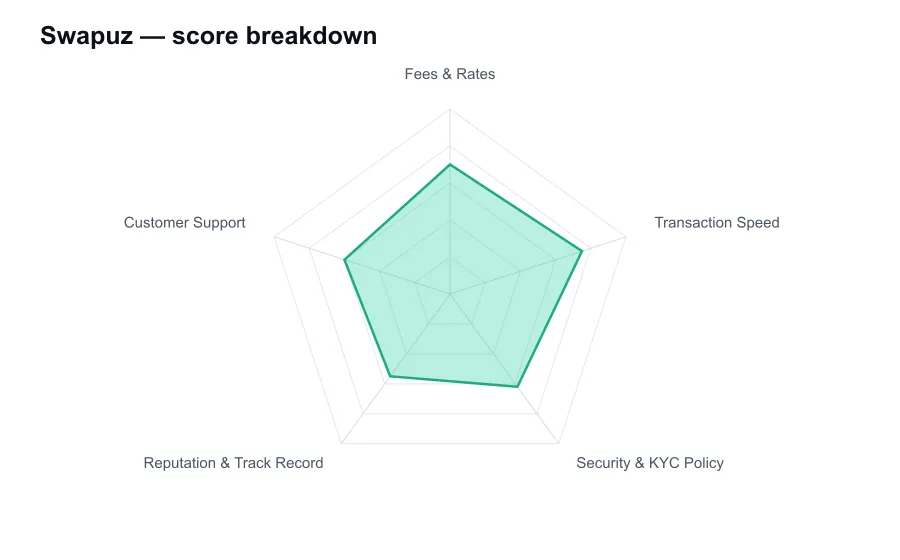
Swapuz scores 6.5/10 overall in our independent review, measured against every other provider we've compared, strongest on Transaction Speed (7.5/10) and weakest on Reputation & Track Record (5.5/10).
Status: active (checked 2026-10-13T18:42:58.526Z)
Editorial independence: our scores and rankings are produced using the fixed criteria above and are not influenced by advertisers. This is an independent ranking site and is not operated by, or affiliated with, any provider we list.
Affiliate disclosure: some links on this page may earn us a commission at no extra cost to you. This does not affect our rankings.
| Best for | No account needed for routine swaps, Fixed-rate and floating-rate quote options, Broad crypto and token selection, Simple interface for one-off conversions |
|---|---|
| Not for | Final all-in spread is not fully transparent, AML checks can still interrupt a no-KYC swap, Less established public track record than major competitors |
What is Swapuz?
Score Breakdown
| Criterion | Score | Note |
|---|---|---|
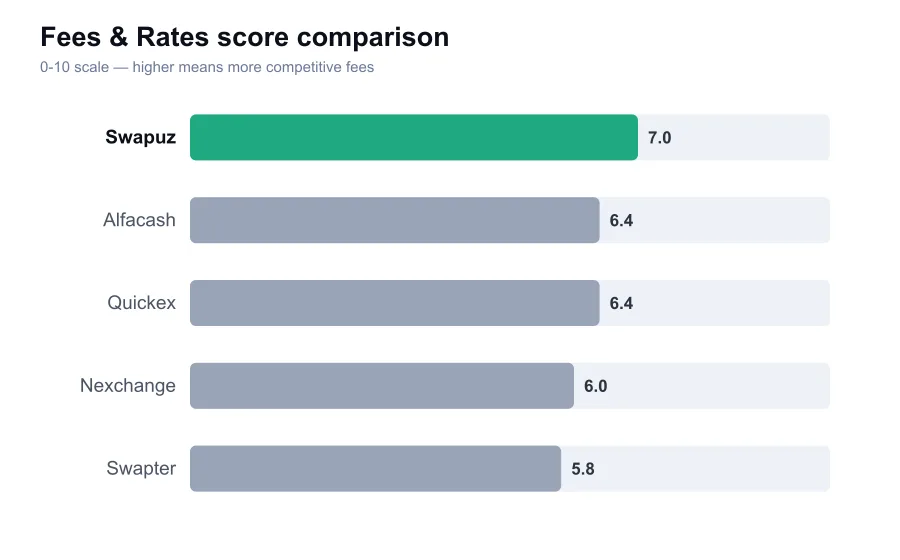
| Fees & Rates | 7.0 | Advertised 0.5% service fee, but final spreads vary by route |
| Transaction Speed | 7.5 | Routine swaps often settle in minutes after confirmations |
| Security & KYC Policy | 6.2 | No standing custody, but AML reviews and partner risk remain |
| Reputation & Track Record | 5.5 | Visible service, though with a shorter public record than leaders |
| Customer Support | 6.0 | Useful for routine cases, less certain during partner-side delays |
| Fact | Value | Source |
|---|---|---|
| Advertised service fee | 0.5% | - |
| Account requirement | Not required for routine swaps | - |
| Rate modes | Fixed and floating | - |
| Custody model | Temporary swap custody | - |
| Quote cost factors | Fee, spread and network fees | - |
Our Review
Swapuz is a non-custodial instant exchange and exchange aggregator aimed at people who want to swap crypto without opening a conventional trading account. It sits somewhere between a simple instant-swap desk and an aggregator such as ChangeNOW or SimpleSwap. You choose an asset pair, send funds to a generated address, and Swapuz routes the order through its own liquidity connections. The appeal is obvious, particularly for users who dislike account creation and trading interfaces. The catch is that the service asks customers to trust an intermediary during each swap, even if it does not hold a standing account balance.
Its interface is clean and easy to understand. A newcomer can select a pair, enter an amount, choose a payout address and see an estimated result without having to understand order books. That is a real advantage over a centralized exchange for one-off conversions. Swapuz also offers fixed-rate and floating-rate choices. Fixed-rate quotes are useful when a volatile asset is moving quickly, though the protection comes at a cost. The quoted amount generally includes a wider margin than a floating quote.
Fees are the first area where marketing language needs a little skepticism. Swapuz has advertised a 0.5% service fee for its exchange service, but that headline figure is not the full economic cost of a trade. Liquidity-provider spreads, network fees and the gap between a displayed floating estimate and final execution can all affect the result. This is normal for instant exchangers, but it makes direct comparison difficult. A user swapping a small amount of BTC into ETH should compare the final amount from Swapuz against Trocador, ChangeNOW, SideShift and a liquid centralized exchange before sending.
For modest swaps, the price can be perfectly reasonable. The convenience premium becomes much clearer on thinly traded assets, large orders and transactions crossing expensive networks. A 0.5% platform fee can turn into a much larger effective difference if the underlying partner has shallow liquidity or if the quote is stale. Swapuz does not provide the kind of transparent execution report that a sophisticated trader would expect from a venue with an order book. You see an offered result, rather than a detailed breakdown of every cost component.
Speed is usually good when the chosen route is healthy. A straightforward Bitcoin, Litecoin, USDT or Ethereum conversion can often move through the system within minutes after the deposit receives the required confirmations. The word usually matters. Bitcoin deposits may need several confirmations, Ethereum can become expensive or congested, and certain partner routes take longer than the initial estimate suggests. Swapuz is not in control of every leg of the transaction, so a delayed partner or blockchain outage can leave an order pending.
The fixed-rate option deserves careful use. It can reduce anxiety during a sharp market move, because it gives the user a defined expected payout if the deposit arrives within the stated window and satisfies the conditions. It is not a magic guarantee against every mistake. Send the wrong token, use an unsupported network, or deposit too late, and a manual recovery process may be necessary. The cheaper-looking floating option is better for users who understand that the final amount may move with the market while confirmations arrive.
Swapuz markets a no-registration, no-KYC experience for routine transactions. That is attractive for privacy-minded users, and it removes one of the worst parts of many centralized exchanges. Still, no-KYC should never be read as no compliance policy. Like other instant exchangers, Swapuz can request identity or source-of-funds information when its risk systems or a liquidity partner flags a transaction. If the customer cannot satisfy the request, funds can remain under review. That possibility should be treated as part of the product, not as obscure fine print.
The service is non-custodial in the limited, practical sense that it does not operate a customer wallet where users keep an ongoing balance. During the exchange, however, the deposit is sent to an address controlled by the exchange process or a partner. That is temporary custody, and it creates counterparty risk. Users should not send funds they cannot afford to have delayed. It is also wise to save the order ID, deposit transaction hash, payout address and screenshots of the quoted rate before making a large transfer.
Swapuz supports a broad selection of major coins and tokens, which is one reason people consider it instead of a small centralized exchange. Breadth is useful, but it introduces a common source of mistakes: token and network confusion. USDT on Ethereum, Tron, BNB Smart Chain and other networks is not interchangeable at the address level. The receiving wallet and the selected Swapuz route must support the exact network. A successful blockchain transfer to an incompatible deposit address may be technically valid while still being very difficult to recover.
Its public reputation is adequate rather than established. Swapuz has been visible in the instant-exchange category for several years and has attracted user feedback, but it does not have the long operating record, deep public company information or institutional standing of Kraken, Coinbase or Bitstamp. It also has less independent community scrutiny than veteran privacy-oriented aggregators such as Trocador. That does not make Swapuz unsafe by default. It does mean customers should apply a higher standard of caution, especially when a swap amount is large enough to hurt.
I would also be careful with review-site scores. Positive reviews often come from uncomplicated transactions, which is fair, but they tell us less about what happens when a partner requests documents, an address is wrong, or a payout is delayed. Negative reports deserve reading too, although they also need context. Many complaints in this category stem from blockchain confirmation delays or an unsupported network choice rather than theft. The decisive question is how transparently the company communicates during a problem, and Swapuz's public support record is still thinner than the strongest names in the sector.
Support is available through the site's contact channels and live-chat style assistance, but expectations should be realistic. Routine order questions can be handled quickly. Complex compliance reviews, partner-side delays and recovery requests tend to take longer because support staff may need to coordinate with another liquidity provider. That is an inherent weakness of aggregation. The customer sees one brand, while the actual transaction may involve several parties with different operating procedures.
The service does have some sensible security habits built into the basic flow. There is no standing password account to compromise for a simple swap, and the user supplies the payout address directly. Yet this also shifts responsibility toward the user. There is no familiar withdrawal whitelist or account-based reversal mechanism. A copied malware address, a fake Swapuz domain or a wrong network selection can be catastrophic. Bookmark the official domain, verify the browser certificate, and make a small test transfer before sending a significant amount.
Swapuz works best as a convenient tool for ordinary, reasonably sized conversions where privacy and simplicity matter more than obtaining the absolute best execution. It is less convincing for active traders, institutions, or anyone moving a large amount who needs detailed pricing, a known legal entity and rapid escalation if something goes wrong. The 0.5% advertised service fee is not outrageous, but the lack of fully transparent all-in execution data keeps it from being a bargain hunter's first choice. I see it as a useful secondary swap route, not a place to route a life-changing transaction without testing it first.
Pros & Cons
| Pros | Cons |
|---|---|
| No account needed for routine swaps | - |
| Fixed-rate and floating-rate quote options | - |
| Broad crypto and token selection | - |
| Simple interface for one-off conversions | - |
How Swapuz Works
- Choose the asset pair and enter the amount
- Select a fixed-rate or floating-rate quote
- Enter and carefully verify the receiving wallet address
- Send the exact asset and network requested to the deposit address
- Track confirmations and receive the converted asset
KYC
| Requirement | optional |
|---|---|
| Notes | Routine swaps are marketed without standard registration or KYC. Swapuz or an underlying liquidity provider may request verification during an AML or risk review. |
Supported Assets
| Notable Coins | Bitcoin, Ethereum, Tether, USD Coin, Litecoin, BNB, Solana, Monero |
|---|
How to Use Swapuz Safely
- Bookmark swapuz.com rather than following sponsored links
- Match the token network exactly before sending
- Test a new route with a small amount first
- Save the order ID and deposit transaction hash
- Compare the final payout with at least one competing quote
FAQ
Does Swapuz charge a fee?
Swapuz has advertised a 0.5% service fee. The final cost can be higher because the quote may also reflect liquidity-provider spread and blockchain network fees.
Does Swapuz require KYC?
Routine swaps are marketed without registration or standard KYC. Compliance checks can still be requested if a transaction is flagged by Swapuz or a liquidity partner.
What is the difference between fixed and floating rates on Swapuz?
A fixed-rate order aims to preserve the quoted payout if you meet its deposit conditions and time window. A floating-rate order follows market movement while the transaction confirms.
Can I send USDT on any network to Swapuz?
No. You must select the exact USDT network offered for that order and send on that same network. ERC-20, TRC-20 and BNB Smart Chain transfers are not interchangeable.
Why is my Swapuz order pending?
Common causes are waiting for deposit confirmations, congestion on the source chain, a liquidity-provider delay or a compliance review. Save the order ID and transaction hash before contacting support.
Is Swapuz non-custodial?
It does not operate a normal customer balance account, but it receives funds during the swap process. That temporary transfer means users still face counterparty risk until the payout arrives.