Nexchange
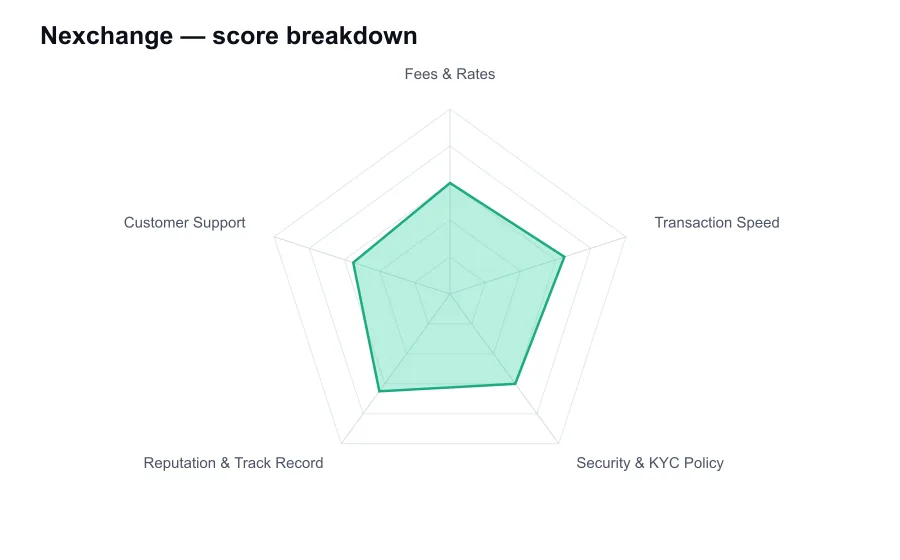
Nexchange scores 6.1/10 overall in our independent review, measured against every other provider we've compared, strongest on Transaction Speed (6.5/10) and weakest on Customer Support (5.5/10).
Status: active (checked 2026-10-13T18:38:51.292Z)
Editorial independence: our scores and rankings are produced using the fixed criteria above and are not influenced by advertisers. This is an independent ranking site and is not operated by, or affiliated with, any provider we list.
Affiliate disclosure: some links on this page may earn us a commission at no extra cost to you. This does not affect our rankings.
| Best for | Established instant-exchange API focus, Simple wallet-to-wallet conversion flow, Useful for developers and one-off swaps, No traditional trading terminal required |
|---|---|
| Not for | Quoted spreads can exceed spot-market costs, Blockchain confirmations govern completion time, Not a trustless or decentralized swap, Large orders need external price comparison |
What is Nexchange?
Score Breakdown
| Criterion | Score | Note |
|---|---|---|
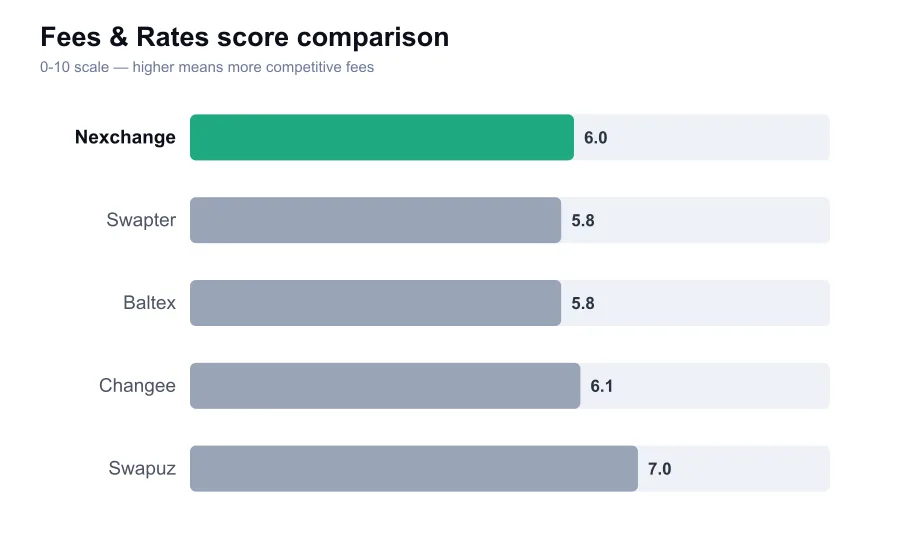
| Fees & Rates | 6.0 | Convenient quote-based execution, but spreads can beat spot fees. |
| Transaction Speed | 6.5 | Efficient order flow, subject to blockchain confirmations. |
| Security & KYC Policy | 6.0 | Transaction-based custody, with risk reviews still possible. |
| Reputation & Track Record | 6.5 | Established API-oriented presence, below major regulated exchanges. |
| Customer Support | 5.5 | Order tracking helps, but exception handling matters most. |
Our Review
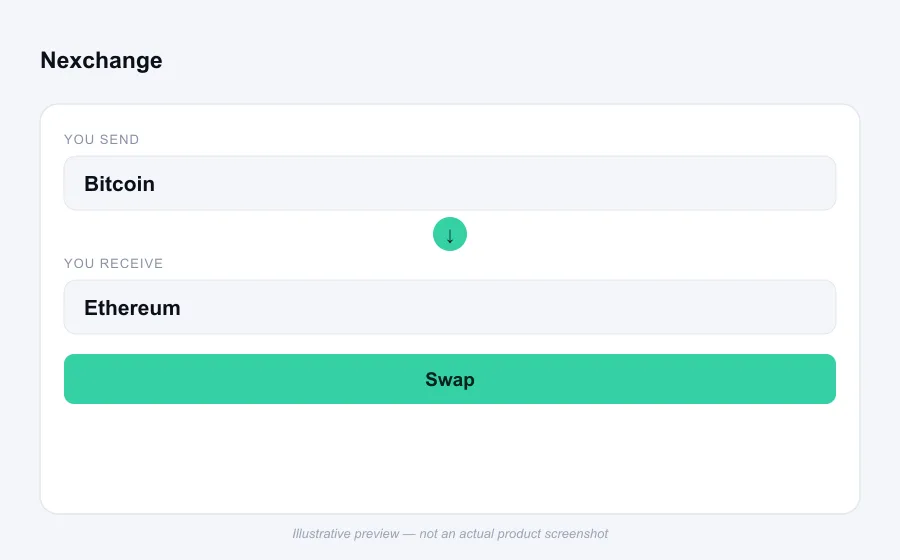
Nexchange is an instant cryptocurrency exchange service and API provider. It is built for a different user from a full trading venue such as Kraken or Coinbase. You choose a conversion, send the deposit, and receive the output in a wallet. Developers can also use its exchange infrastructure rather than build every conversion route themselves.
That position is more credible than the typical anonymous swap page because Nexchange has been known primarily as an exchange API and white-label style infrastructure product. Still, users should keep the distinction clear. This is not an order-book exchange where you place a limit order and retain custody until a match occurs. Execution is quote-based and transaction-driven.
The practical advantage is simplicity. There is no need to learn a trading terminal, fund a standing account, or manage separate balances across several venues. For a one-off wallet-to-wallet conversion, that can be much less frustrating than opening a centralized exchange account, waiting for account approval, and then handling a withdrawal.
Fees deserve a closer look than the clean interface encourages. Nexchange's final quote may include the service margin, market conversion cost, liquidity-provider pricing, and network expense. That is normal for instant exchanges. It also means users should judge pricing by the exact output amount, not by looking for a single visible percentage.
For small swaps, the convenience premium can be acceptable. For larger transactions, it can become expensive quickly. A user converting a substantial Bitcoin amount should compare Nexchange's quote with a liquid spot exchange, an OTC desk where appropriate, and at least one competing instant exchanger. Spreads matter more than a small fixed fee once the order grows.
Rate movement is another issue. A floating quote can change between the moment an order is created and the time the deposit reaches sufficient confirmations. Bitcoin deposits are particularly exposed because confirmation time can vary. A fixed-rate option, where available for a pair, reduces market risk but may include a higher buffer in the quoted return.
Nexchange generally makes most sense for users who value execution convenience rather than the absolute best price. That is a defensible service model. It becomes less attractive when a provider is vague about rate type, deposit deadline, or what happens if the user sends too little, too much, or uses an unsupported network.
Speed is decent by instant-exchange standards, but no honest review should promise a universal completion time. A swap can only proceed after the incoming chain confirms it. Fast networks can settle quickly, while Bitcoin, Ethereum during congestion, and privacy coin routes can take much longer. The outgoing transfer then has its own confirmation cycle.
Nexchange's API-oriented background is a point in its favor for operational discipline. Services supplying other businesses must handle order creation, status monitoring, and address generation consistently. Even so, API competence is not a substitute for a consumer-friendly dispute process. A stalled order is still stressful if a user cannot get a clear answer.
The platform's security model is better understood as limited-duration custody. Nexchange does not operate like a retail exchange balance account for ordinary swap flow, but it takes possession of the deposited asset while the order is processed. That reduces long-term exchange exposure, yet it means the user must still trust the firm, its wallet infrastructure, and its compliance controls.
KYC should be approached realistically. A lack of conventional sign-up friction does not create an unconditional right to anonymous exchange execution. Risk-based checks, sanctions screening, and suspicious-transaction review can affect an order. Anyone who cannot or will not provide source information should avoid sending funds on the assumption that a review can never happen.
Nexchange has a better reputation score than small, opaque swap brands because it has an identifiable product role and a longer visible presence in exchange infrastructure. It is still not in the same trust bracket as a regulated major exchange with published audits, licensing disclosures, and a huge body of independently reviewed user history.
Support is useful for normal order questions, but instant exchange support is only tested during exceptions. Before using a meaningful amount, confirm where you can find order status, how to contact the team, and what evidence they need if your deposit is delayed. Save the order identifier and transaction hash immediately.
My take is that Nexchange is a reasonable convenience service for technically literate users who understand quoted execution. It is more credible than a newly appeared anonymous swap site, and its API roots are meaningful. But it remains a counterparty-based exchange route, not a substitute for self-custody discipline or the depth and protections of a major trading venue.
Pros & Cons
| Pros | Cons |
|---|---|
| Established instant-exchange API focus | - |
| Simple wallet-to-wallet conversion flow | - |
| Useful for developers and one-off swaps | - |
| No traditional trading terminal required | - |
How Nexchange Works
- Choose the deposit and receive assets
- Enter the amount and receiving wallet address
- Review whether the quote is floating or fixed
- Send the deposit to the generated address before any deadline
- Monitor order status until the payout is broadcast
KYC
| Requirement | tiered |
|---|---|
| Notes | The service can be used without a traditional retail trading account, but risk-based compliance checks may affect an order. Do not assume that verification can never be requested. |
Supported Assets
| Notable Coins | Bitcoin, Ethereum, Litecoin, Monero |
|---|
How to Use Nexchange Safely
- Compare the final payout with a liquid exchange before large swaps
- Check whether your order uses a floating or fixed rate
- Send only on the exact network shown in the order
- Keep the order ID and deposit transaction hash
- Use a wallet address you control and verify it before submission
FAQ
Is Nexchange a regular cryptocurrency exchange?
Not in the usual order-book sense. Nexchange primarily provides quote-based, wallet-to-wallet exchanges and API infrastructure rather than a conventional trading terminal.
Why can my Nexchange quote change?
A floating-rate order can move before the deposit is confirmed. Bitcoin and congested networks are more exposed because confirmation time is variable.
Is Nexchange cheaper than buying on a spot exchange?
Not always. Its fees score 6.0 out of 10 because the final quote can include spread and network costs. Compare the receive amount with spot execution for larger orders.
Can a swap be reviewed for compliance?
Yes. A streamlined swap flow does not prevent risk-based checks. Do not send an amount that you could not explain or document if a review occurs.
What should I do if a deposit is delayed?
Check the deposit transaction on the relevant blockchain, then keep the Nexchange order ID and transaction hash ready when contacting support.
Who is Nexchange best for?
It is particularly relevant to developers and wallet users who need conversion infrastructure or a simple one-off exchange, rather than active order-book traders.