CCECash
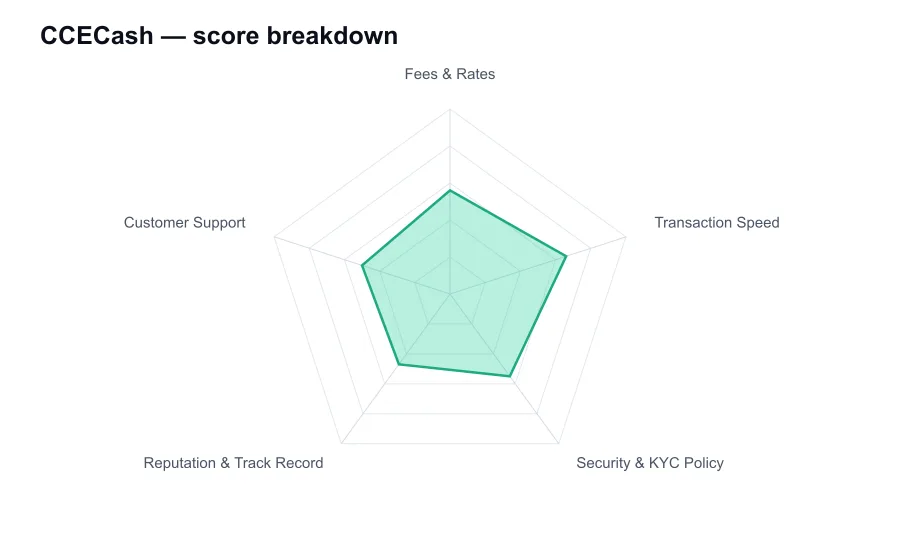
CCECash scores 5.5/10 overall in our independent review, measured against every other provider we've compared, strongest on Transaction Speed (6.6/10) and weakest on Reputation & Track Record (4.7/10).
Status: active (checked 2026-10-13T18:26:01.459Z)
Editorial independence: our scores and rankings are produced using the fixed criteria above and are not influenced by advertisers. This is an independent ranking site and is not operated by, or affiliated with, any provider we list.
Affiliate disclosure: some links on this page may earn us a commission at no extra cost to you. This does not affect our rankings.
| Best for | Direct wallet-to-wallet swap flow, No conventional trading account for the core use case, Useful for small self-custody conversions, Avoids leaving a long-term exchange balance |
|---|---|
| Not for | Limited independent reputation evidence, No transparent public fee schedule, Not appropriate for urgent or large transactions, Compliance checks can still interrupt a swap |
What is CCECash?
Score Breakdown
| Criterion | Score | Note |
|---|---|---|
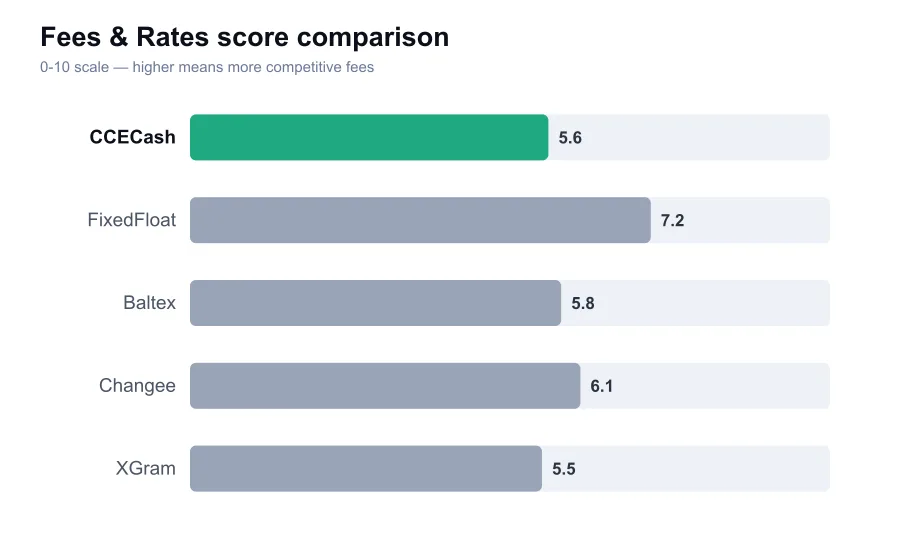
| Fees & Rates | 5.6 | The all-in cost is embedded in a live conversion quote. |
| Transaction Speed | 6.6 | Normal swap timing depends heavily on the source chain. |
| Security & KYC Policy | 5.5 | Self-custody endpoints help, public security detail is limited. |
| Reputation & Track Record | 4.7 | A smaller public footprint warrants conservative transaction sizing. |
| Customer Support | 5.0 | Support channels exist, but resolution history is hard to assess. |
| Fact | Value | Source |
|---|---|---|
| Service type | Instant cryptocurrency exchanger | Source |
| Trading model | Quote-based conversion | Source |
| Account model | No conventional trading account | Source |
| Custody model | Transaction-based exchange flow | Source |
| Settlement dependency | Blockchain confirmation dependent | Source |
Our Review
CCECash is a small instant cryptocurrency exchange built for direct wallet-to-wallet conversions. It is not a conventional trading venue, and it does not try to compete with Binance, Coinbase, or Kraken on order-book depth, advanced tools, or regulatory infrastructure. Its pitch is simpler: choose an asset pair, send crypto to an order address, and receive the converted asset without maintaining a full trading account.
That model has genuine appeal. A user who already holds crypto in self-custody may not want to deposit it at a large exchange, pass through a long sign-up flow, make a trade, and then withdraw again. CCECash compresses that process into a single conversion. For a straightforward swap, that is much more convenient than a centralized exchange account.
Convenience is also where the pricing risk begins. CCECash uses quote-based pricing, so the service's margin is generally folded into the displayed conversion result. You may see an expected amount and an exchange rate, but there is no simple public maker-taker schedule that tells you exactly how much is liquidity cost, platform revenue, or network expense. The number that matters is the payout.
I would never accept the first quote from a lesser-known instant exchange without comparison. Open the same pair and amount at a few services, account for the output network fee, and compare the exact destination amount. On highly liquid coins the difference may be modest. On stablecoin routes, small tokens, or volatile markets, it can become surprisingly expensive. A quick quote comparison is the best fee discipline available.
CCECash has a lighter public footprint than the leading instant-exchange brands. That does not prove it is unsafe, but reputation is built from more than a working website. Major competitors have years of independent customer discussion, public company information, visible integrations, and a large volume of documented support experiences. CCECash offers less of that reassurance.
For this reason, transaction size matters. I can see a rational case for using CCECash for a small, ordinary conversion if the live quote is attractive and the required network is clearly supported. I would not recommend sending a large portion of a portfolio, an urgent settlement payment, or assets needed for a time-sensitive trade. The reduction in account friction does not compensate for limited counterparty evidence.
Speed follows the standard mechanics of an instant exchanger. The service can generate an order immediately, but it must wait for your incoming blockchain transaction and then source or release the output asset. A fast chain can make the flow feel quick. Bitcoin deposits, congested Ethereum transactions, and transfers sent with too-low miner fees can turn the same process into a long wait.
The distinction between a fixed and floating quote deserves care. A floating transaction tracks market conditions and can change before completion. A fixed quote seeks to protect the specified conversion during a limited time window, but it relies on you sending the exact amount promptly. If your deposit confirms after the window or differs from the expected amount, the transaction may need manual reconciliation.
CCECash may permit a user to begin a swap without standard account registration. That is useful for people who do not want to create another custodial profile. It does not create an unconditional anonymity promise. Instant exchanges, their payment partners, and liquidity providers can apply anti-money-laundering screening and may ask for additional information where a transaction generates a compliance alert.
That possibility should influence how you use it. Don't send a transaction that would cause serious hardship if it were paused while you provided documents or waited for a review. Do not attempt to circumvent a compliance request by opening duplicate orders or sending from multiple addresses. Those actions can make a routine case look worse and reduce the chance of a swift resolution.
Security is strongest at the edges of the transaction. Use a wallet you control as the sending wallet and another address you control as the recipient. Verify the chain name as well as the asset symbol. USDT on Tron, Ethereum, BNB Smart Chain, and other networks is not interchangeable, and a wrong-network transfer can be difficult or impossible for a small exchange to recover.
The customer support experience is difficult to score highly because the public record is limited. A contact channel is necessary, but it is not the same thing as proven resolution quality during complex failures. Before using CCECash, look for the support instructions attached to the order, preserve screenshots and transaction hashes, and make sure you can supply evidence if a deposit needs to be traced.
CCECash does have one advantage over custodial trading accounts: it does not ask the ordinary user to leave assets sitting in a platform wallet. The intended relationship is temporary. That reduces exposure if you follow through and receive the output into self-custody. It does not remove counterparty risk during the swap itself, and it does not protect a user from an irreversible address mistake.
My take is straightforward. CCECash can be a practical tool for a small, non-urgent swap by a user who understands blockchains and has compared the final quote. It lacks the reputation, transparency, and support evidence I would want before trusting it with significant capital. Keep the test amount modest, keep records, and choose a better established service if certainty matters more than avoiding account creation.
Pros & Cons
| Pros | Cons |
|---|---|
| Direct wallet-to-wallet swap flow | - |
| No conventional trading account for the core use case | - |
| Useful for small self-custody conversions | - |
| Avoids leaving a long-term exchange balance | - |
How CCECash Works
- Select the input and output cryptocurrencies
- Enter the amount and review the quoted result
- Supply a receiving address on the correct output network
- Send the exact deposit amount to the generated address
- Wait for the deposit confirmations and output transfer
KYC
| Requirement | optional |
|---|---|
| Notes | The normal swap flow may not require a conventional account. CCECash or its partners can request identity or transaction information if automated compliance checks flag an order. |
Supported Assets
| Notable Coins | Bitcoin, Ethereum, Litecoin, Tether, USDC |
|---|
How to Use CCECash Safely
- Compare the final payout with other services before sending
- Run a modest test order with a new provider
- Match the exact coin and blockchain network shown in the order
- Save the order ID, screenshots, and deposit transaction hash
- Use self-custody addresses at both ends of the swap
FAQ
Is CCECash a normal crypto trading exchange?
No. CCECash is an instant exchanger. It processes a one-off conversion between wallet addresses rather than providing a conventional order book, trading account, or portfolio-management platform.
How does CCECash charge for a swap?
Its pricing is generally incorporated into the conversion quote. Check the final amount expected at your destination address and compare that amount with other instant exchange services.
Can CCECash ask for identity documents?
Yes. A standard order may begin without conventional exchange onboarding, but compliance screening can result in a request for identity or transaction information on a flagged swap.
Why has my CCECash order not completed?
The incoming deposit may still be awaiting confirmations, may have been sent with a low network fee, may not match the requested amount, or may require a manual review.
Can I send USDT on any network to CCECash?
No. You must use the exact network shown on the order. USDT exists on several chains, and sending it through a different chain can make recovery difficult or impossible.
Should I make a test transaction first?
Yes, especially with a smaller provider. Test the asset pair and network with a modest amount, then confirm the received amount and timing before sending a larger order.