XGram
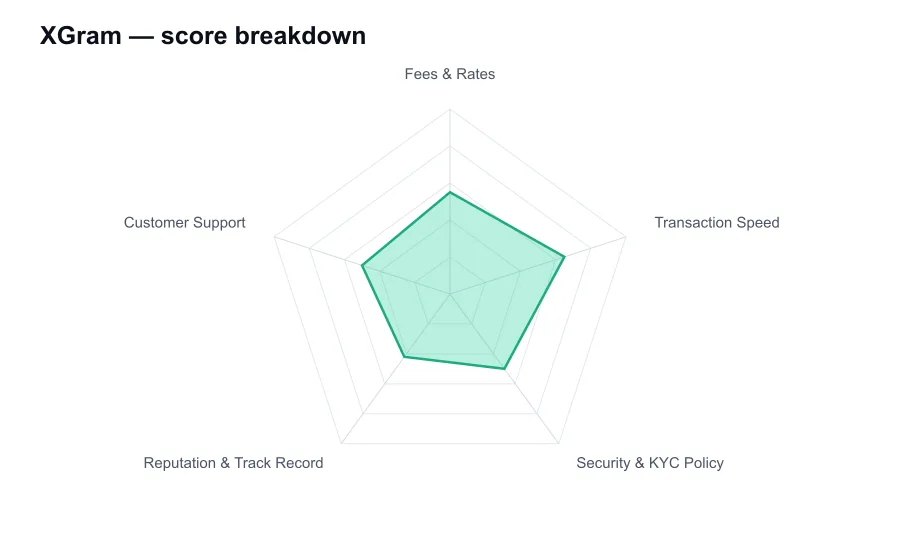
XGram scores 5.3/10 overall in our independent review, measured against every other provider we've compared, strongest on Transaction Speed (6.5/10) and weakest on Reputation & Track Record (4.2/10).
Status: active (checked 2026-10-13T18:42:58.620Z)
Editorial independence: our scores and rankings are produced using the fixed criteria above and are not influenced by advertisers. This is an independent ranking site and is not operated by, or affiliated with, any provider we list.
Affiliate disclosure: some links on this page may earn us a commission at no extra cost to you. This does not affect our rankings.
| Best for | Simple no-account swap flow, Useful for quick crypto-to-crypto conversions, Fixed and floating quotes may be available by route, No long-term customer balance account |
|---|---|
| Not for | Limited public fee breakdown, Less established reputation than leading alternatives, Limited independent security and company transparency, Complex delays may be hard to escalate |
What is XGram?
Score Breakdown
| Criterion | Score | Note |
|---|---|---|
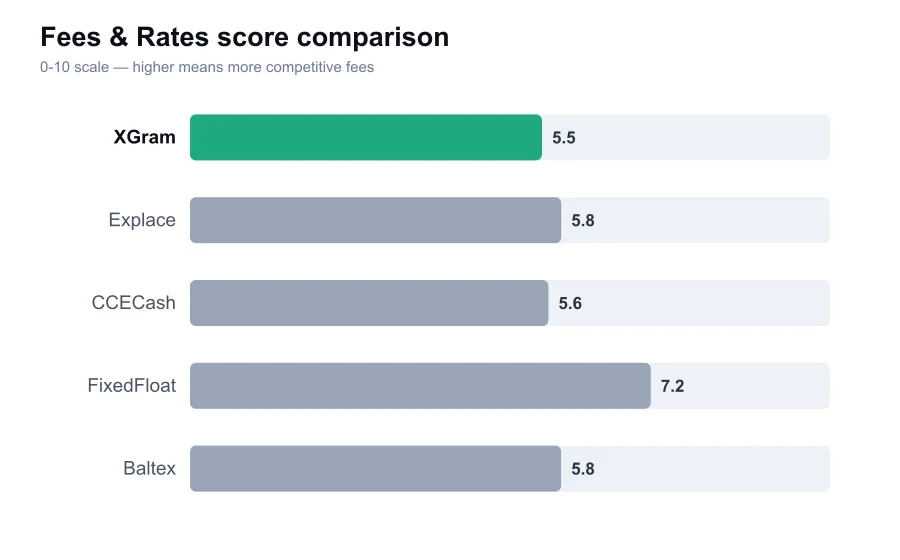
| Fees & Rates | 5.5 | Quoted pricing lacks the fee transparency of stronger aggregators |
| Transaction Speed | 6.5 | Typical instant-swap timing, subject to chains and liquidity routes |
| Security & KYC Policy | 5.0 | Temporary swap custody and limited public security detail |
| Reputation & Track Record | 4.2 | Active service, but with a comparatively thin public track record |
| Customer Support | 5.0 | Support channels exist, but complex cases may depend on partners |
| Fact | Value | Source |
|---|---|---|
| Business model | Instant cryptocurrency exchange | - |
| Account requirement | Not routinely required | - |
| Rate modes | Fixed or floating by route | - |
| Custody model | Temporary custody during swaps | - |
| Pricing method | Quote includes route-specific costs | - |
Our Review
XGram is an instant cryptocurrency exchange service built for quick conversions rather than active trading. It follows the familiar no-account swap model: select a pair, provide a destination address, send the deposit and wait for the converted asset. That puts it in a crowded group alongside services such as ChangeNOW, SimpleSwap, LetsExchange and dozens of smaller operators. XGram's challenge is not explaining the product. The product is simple. Its challenge is earning enough public trust to justify choosing it over better known alternatives.
The site is straightforward and generally accessible to someone who has used a wallet before. There is no order book, no portfolio screen and no need to learn spot-trading terminology. For a user who wants to turn ETH into BTC or exchange a stablecoin for another chain's native token, that simplicity has real value. A conventional exchange can be cheaper, but it also requires registration, deposits, trading and withdrawal steps. XGram condenses that into a single transaction flow.
Pricing is where I become less enthusiastic. XGram provides a quote, often with a fixed-rate or floating-rate choice depending on the route, but it does not have the same level of public fee transparency as the strongest comparison services. The number that matters is the final amount arriving in the destination wallet. A quoted result can contain a provider margin, liquidity spread and network costs even where no large standalone platform fee is highlighted. Without a clearly published universal fee schedule, users have to compare results manually.
That does not mean its rates are automatically poor. An instant exchange can occasionally produce a competitive quote because of a particular liquidity partner or market condition. The problem is repeatability. A user cannot safely assume that a good BTC-to-ETH quote today means XGram will be strong for USDT-to-SOL tomorrow. Before sending, compare the identical amount and network against Trocador, ChangeNOW, SimpleSwap and, if practical, a liquid centralized exchange. This takes a minute and can save much more than any supposed convenience advantage.
For small swaps, XGram's quote-first design is sufficient. For larger transfers, the limited cost detail is a concern. The difference between a fair price and an expensive one is often hidden in the exchange rate rather than shown as a fee line. Fixed-rate swaps may have a worse initial rate because the provider is taking price-movement risk. Floating-rate swaps can produce a different payout if the market changes before the deposit confirms. Neither option is inherently bad, but customers need to understand what they are buying.
Transaction speed is broadly typical of this category. A swap can complete quickly after the incoming payment reaches the required confirmation threshold and the selected route has liquidity. Faster chains and common pairs usually work well. Bitcoin deposits, congested Ethereum transactions and low-liquidity tokens can take materially longer. XGram cannot bypass blockchain finality, and users should be wary of treating any estimated completion time as a guarantee, especially during volatile markets.
A delayed order is not automatically evidence of misconduct. It may reflect an unconfirmed deposit, a low network fee paid by the sender, wallet maintenance or a liquidity partner processing the order. Yet this is where smaller instant exchanges are judged most harshly, fairly enough. A large, well-known service often has deeper operational resources and more public accountability when a case stalls. XGram gives customers fewer independent reasons to feel comfortable if a transaction becomes complicated.
XGram presents itself as a service that can be used without routine registration, which is a meaningful convenience and privacy benefit. But users should not confuse this with an unconditional promise of anonymity. Instant exchanges use transaction-monitoring systems and often rely on external liquidity providers, each with its own compliance obligations. A transaction linked to suspicious activity, sanctions exposure or other risk signals can trigger a request for identification or source-of-funds evidence. Until that review is resolved, the transaction may be delayed.
The temporary-custody issue also deserves plain language. XGram may not ask customers to leave funds in a long-term account, but the customer still sends coins into an address involved in XGram's exchange process. That party controls the funds for the duration of the swap. The distinction between non-custodial branding and actual transaction control matters most when something goes wrong. Do not use an instant exchanger for funds that must be available immediately, and never send a larger amount than you would be comfortable having tied up temporarily.
XGram's security posture is difficult to score highly because public detail is limited. There is no widely recognized institutional security program, audited proof-of-reserves framework or long public record comparable to leading centralized exchanges. That is not an unusual situation for a no-account swap service, but it is still a weakness. The best protection is procedural: use the correct official domain, confirm every address, keep your wallet secured and test the service before using it for an important transaction.
Reputation is XGram's softest category. It is active and has a functioning service, but it does not carry the weight of a long-lived brand such as Kraken or the specialist credibility Trocador has developed since 2017. Independent discussion and detailed third-party scrutiny are comparatively limited. In this part of crypto, absence of a famous failure is not enough to create confidence. A provider needs years of consistent execution, clear policies and visible problem resolution. XGram has less evidence on those points than I would like.
Customer support appears to be available through the site's support channels, but users should set expectations according to the platform's scale. Simple status questions may be resolved quickly. Problems involving a failed payout, wrong-chain deposit, compliance review or a partner delay are much more demanding. Since the service may depend on external routes, frontline support might need to seek information from another party before it can give a useful answer. That can turn an ostensibly instant swap into a frustrating wait.
Asset choice is useful for a service of this type, but breadth can be deceptive. The important question is not whether a coin appears in a selector. It is whether the exact pair, chain and payout route are available at the moment the order is created. Token names can hide major differences between networks. Sending USDT through the wrong chain, or using a wrapped version of an asset where a native version is expected, is one of the most common and expensive user errors in instant swaps.
XGram is therefore best treated as one quote source among several rather than a default venue. If it offers the best final result for a small, standard pair, there is no reason not to consider it. But compare carefully, use a test amount and keep a record of the order. The service has not supplied enough public evidence for me to recommend sending a large amount on trust alone. A strong rate is a reason to investigate, not a reason to suspend caution.
My final view is that XGram is serviceable but not yet distinguished. Its no-account flow and simple interface solve a real problem for crypto users who need a quick conversion. Its weaker fee transparency, lighter public reputation and limited independently verifiable security information make it a secondary option. It can be useful for a modest swap after comparing quotes. For large transactions, compliance-sensitive funds or users who need a well-established support structure, the safer choice is a more proven exchange or an aggregator that exposes more about the route.
Pros & Cons
| Pros | Cons |
|---|---|
| Simple no-account swap flow | - |
| Useful for quick crypto-to-crypto conversions | - |
| Fixed and floating quotes may be available by route | - |
| No long-term customer balance account | - |
How XGram Works
- Select the cryptocurrency pair and amount
- Choose the available fixed or floating quote if offered
- Enter the destination wallet address
- Send the requested asset to the generated deposit address
- Wait for network confirmations and the outgoing payout
- Keep the order details and transaction hash until completion
KYC
| Requirement | optional |
|---|---|
| Notes | XGram can be used without routine account registration, but risk monitoring or an AML review may lead to an identity or source-of-funds request. |
Supported Assets
| Notable Coins | Bitcoin, Ethereum, Tether, USD Coin, Litecoin, BNB, Solana |
|---|
How to Use XGram Safely
- Use the official xgram.io address and check it carefully
- Compare the final payout with other instant exchangers
- Send the exact asset and network requested by the order
- Make a small test swap before a larger transfer
- Save the order ID, quoted payout and deposit hash
FAQ
Does XGram publish a flat exchange fee?
XGram primarily presents an exchange quote rather than a clearly universal public flat-fee schedule. Compare the final payout because spread, liquidity costs and network fees can affect it.
Does XGram require KYC?
Routine use is presented as no-account swapping, but verification can still be requested during an AML or risk review. No-registration access should not be treated as guaranteed anonymity.
Why did my XGram payout take longer than expected?
Delays can result from blockchain confirmations, network congestion, wallet maintenance, a liquidity-route issue or a compliance review. Keep the deposit hash and order details for support.
Can I use XGram for a large crypto transfer?
You can create a quote, but a large transfer carries temporary counterparty and compliance risk. Test XGram first with a small amount and compare its final payout with established alternatives.
Does XGram hold a customer balance?
XGram is designed around individual swaps rather than a conventional long-term customer account. It still receives or controls funds during the exchange process until the payout is made.
Can I send USDT on a different network than the one selected?
No. Send only the exact token and network shown in the order. A USDT transfer on the wrong chain can be difficult or impossible to recover.
Should I choose a fixed or floating XGram rate?
Choose fixed if you value a defined quoted payout and can meet the deposit conditions. Choose floating if you accept that the final amount may move while the transaction confirms.