ETZ
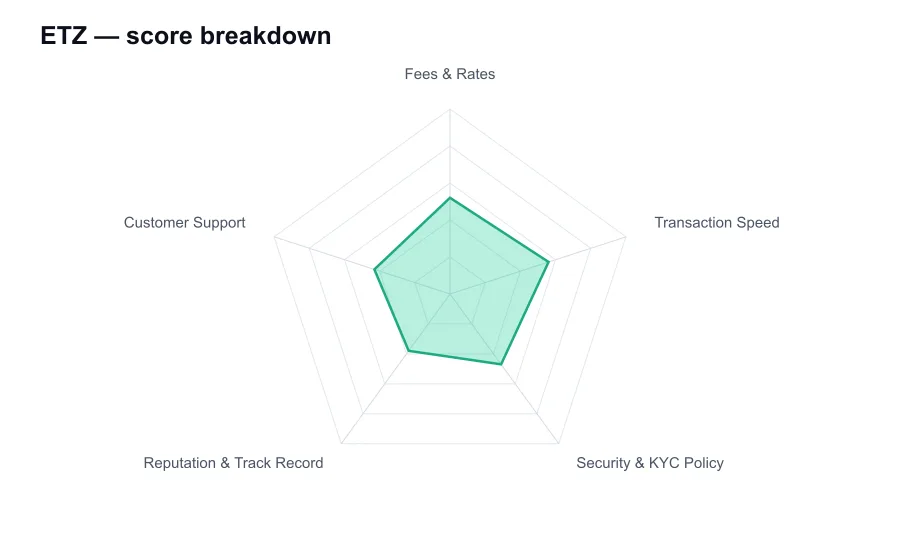
ETZ scores 4.8/10 overall in our independent review, measured against every other provider we've compared, strongest on Transaction Speed (5.6/10) and weakest on Reputation & Track Record (3.8/10).
Status: active (checked 2026-10-13T18:32:27.710Z)
Editorial independence: our scores and rankings are produced using the fixed criteria above and are not influenced by advertisers. This is an independent ranking site and is not operated by, or affiliated with, any provider we list.
Affiliate disclosure: some links on this page may earn us a commission at no extra cost to you. This does not affect our rankings.
| Best for | Simple transaction-based swap model, May suit a small test conversion, Does not appear built around a permanent trading balance |
|---|---|
| Not for | Limited independently verifiable operating history, Fee and spread transparency are hard to assess, Little evidence for handling difficult support cases, Not a sensible choice for large or urgent transfers |
What is ETZ?
Score Breakdown
| Criterion | Score | Note |
|---|---|---|
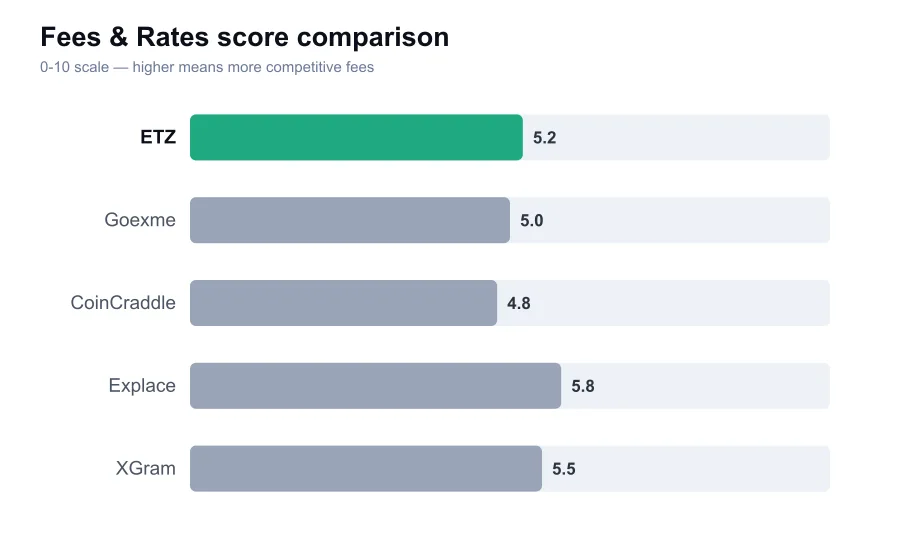
| Fees & Rates | 5.2 | Final quote needs comparison, fee transparency is limited |
| Transaction Speed | 5.6 | Standard swap model, limited independent execution history |
| Security & KYC Policy | 4.7 | Transaction-based flow, but limited public disclosure |
| Reputation & Track Record | 3.8 | Thin independently verifiable track record |
| Customer Support | 4.3 | Test support before trusting it with a meaningful transfer |
| Fact | Value | Source |
|---|---|---|
| Service model | Instant cryptocurrency exchange | - |
| Custody model | Transaction-based swap flow | - |
| Pricing | Quote shown before payment | - |
| Public track record | Limited independently verifiable history | - |
| Recommended use | Small test transactions only | - |
Our Review
ETZ is presented as an instant cryptocurrency exchange service, but it occupies the least established position of the four providers reviewed here. The basic promise is familiar: choose two assets, send crypto to a generated address, and receive the converted asset without operating a conventional custodial trading account. The service may be convenient for a quick swap, yet the lack of a deep, independently verifiable public record is impossible to ignore. This is a category where a polished interface is cheap and a trustworthy history is much harder to build.
The first difficulty with ETZ is not necessarily its swap mechanism. It is the scarcity of transparent information about the business behind it. A careful customer should be able to identify the operating entity, applicable terms, compliance process, customer-contact route, and dispute path before sending meaningful funds. With established companies, that information is usually easy to trace through legal pages, company records, years of public discussion, and detailed user reports. ETZ does not offer the same level of confidence or visibility.
That makes fee evaluation unusually difficult. Instant exchangers rarely charge only one simple fee. Their advertised price can combine a service charge, a partner spread, liquidity cost, and blockchain mining fee. ETZ may show a quote before the transaction is created, but that quote should be treated as the key number. Do not assume a low-looking headline rate means cheap execution. Compare the destination amount against EasyBit, Exolix, ChangeNOW, and a liquid exchange before sending.
For a small swap, the difference may be only a few dollars. For a larger conversion, an opaque spread can cost more than the network fee by a wide margin. The worst time to discover that is after your deposit has been confirmed. If ETZ offers a fixed quote, read the payment window carefully. Fixed rates only work as intended if your payment reaches the designated address in the required period and with the exact amount. A late Bitcoin payment can turn an apparently fixed transaction into an exception case.
Speed claims also need to be put in their proper place. An instant exchanger does not settle before the underlying deposit chain recognizes the payment. A Bitcoin transaction with a low miner fee can remain unconfirmed for a long time. Ethereum, Tron, Solana, and other networks each have their own finality and congestion patterns. The provider's useful contribution begins after the deposit is recognized: sourcing the counterasset, calculating the final output, and broadcasting the payout without sitting on the order.
There is not enough well-documented independent evidence to rank ETZ alongside long-running instant-exchange brands for consistent execution. That does not mean every ETZ order fails or that the service is necessarily unsafe. It does mean the burden of caution should be higher. I would not use a lightly documented service for a time-sensitive settlement, a large stablecoin conversion, or an order where a delay would cause a liquidation or missed payment. A test transaction is mandatory, not optional.
ETZ appears to operate on a non-custodial, transaction-based model rather than as a conventional exchange wallet. That is a useful feature because users are not encouraged to leave balances in a platform account. But the term non-custodial is often misunderstood. During an exchange, the deposited funds are under the service's operational control. You still rely on it and its liquidity providers to complete the conversion. There is no smart-contract guarantee, no order book you can inspect, and no public proof that funds are segregated.
KYC is another area where customers should avoid assumptions. Many instant exchange sites market convenience and minimal signup, then reserve the right to request documents under AML procedures. ETZ users should assume this is possible unless the terms say otherwise in unambiguous language. If privacy is central to your decision, do not send funds first and investigate the policy later. Read the current terms, make sure you can comply if asked, and avoid using a swap service for funds whose source you cannot document.
Reputation is ETZ's central weakness. Its public footprint is not comparable with the established names in this segment, and there is limited material from credible independent sources to assess long-term behavior in difficult cases. A few positive or negative comments do not solve that problem. Reviews can be manipulated, and crypto users often lack the transaction context needed to evaluate a complaint. What matters is sustained evidence over time, clear ownership, visible support activity, and a pattern of resolving exceptions. ETZ has not yet earned a high score on those measures.
Support is therefore a practical concern, not merely a scorecard category. If a transaction gets stuck, users need a reply that identifies the order, explains the issue, and gives a real next step. A generic message about blockchain delays is inadequate if the deposit has already received confirmations. Before using ETZ, test the support channel with a specific pre-sale question. Ask which network variant is accepted for the asset you intend to send. The speed and precision of that answer will tell you more than a marketing claim.
There is also a real risk in relying on an unfamiliar brand for recovery work. Sending an unsupported token, omitting a required memo or tag, or choosing the wrong network may require manual recovery. Larger exchanges sometimes have specialized teams and documented recovery procedures. Small instant exchangers can have limited ability to retrieve anything, especially if a partner controls the deposit address. Assume that a wrong-network transfer can be unrecoverable. This is true everywhere, but it matters more where the provider's operational depth is unclear.
ETZ may still have a role for technically competent users who want to test a small transaction and are comfortable managing their own custody. The service's simple model can be attractive if its live quote happens to be strong for a particular pair. But this is not a provider I would recommend by default. The market offers alternatives with a much clearer business history, richer public documentation, and more extensive records of handling customer problems.
A sensible way to use ETZ, if you decide to do so, is deliberately conservative. Start with an amount you can afford to lose or leave pending. Verify the exact asset ticker and chain. Record every screen before payment, including the promised payout and expiry time. Send the precise amount, preferably from a wallet that lets you control the miner fee. Then wait for the order status rather than sending duplicate deposits, which can create a second reconciliation problem.
My view is straightforward. ETZ has the basic shape of an instant exchange, but it has not built enough public trust to deserve the same confidence as a mature service. The uncertainty around operating history, pricing transparency, and independent reputation outweighs the appeal of a quick no-account swap. It might be acceptable for a carefully tested low-value conversion. For anything substantial, choose a provider with a stronger record or use a regulated exchange where you can see the trade, the fee, and the withdrawal process clearly.
Pros & Cons
| Pros | Cons |
|---|---|
| Simple transaction-based swap model | - |
| May suit a small test conversion | - |
| Does not appear built around a permanent trading balance | - |
How ETZ Works
- Select the asset you want to send and receive
- Review the displayed payout and payment deadline
- Provide a wallet address for the converted asset
- Send the exact amount to the generated address
- Track the order until the payout transaction is sent
KYC
| Requirement | optional |
|---|---|
| Notes | Routine registration may not be part of the basic swap flow, but users should assume AML and identity checks can be requested in an exception or risk-review case. |
How to Use ETZ Safely
- Use a small test transaction before sending a large amount
- Compare the final payout with at least two alternatives
- Verify the blockchain network, not only the token ticker
- Record the quote, expiry time, order ID, and transaction hash
- Do not use ETZ for a deadline-sensitive payment
FAQ
Should I use ETZ for a large crypto swap?
No. ETZ's reputation score here is 3.8 out of 10 because its independently verifiable public track record is limited. Use a small test amount first, or choose a more established provider.
Does ETZ require KYC?
Do not assume that it never does. Instant exchange services can request identity documents under AML controls even where routine registration is not part of the normal order flow.
Why should I compare ETZ's final payout with other services?
An instant-exchange quote can include a service charge, liquidity spread, and network cost. Comparing the amount you will receive is more useful than relying on a headline fee.
Can ETZ make a Bitcoin swap instant before confirmations?
No. The service must first recognize the incoming Bitcoin transaction. Confirmation time depends on the Bitcoin network and the miner fee attached to the deposit transaction.
What should I save before sending funds to ETZ?
Save the order ID, quoted payout, payment expiry time, deposit address, destination address, and transaction hash. Those details are essential if the swap needs manual support.
What happens if I send an unsupported network asset?
Recovery may be difficult or impossible. Do not send an asset merely because its ticker matches. Confirm the exact blockchain network shown in the ETZ order before you broadcast.