Goexme
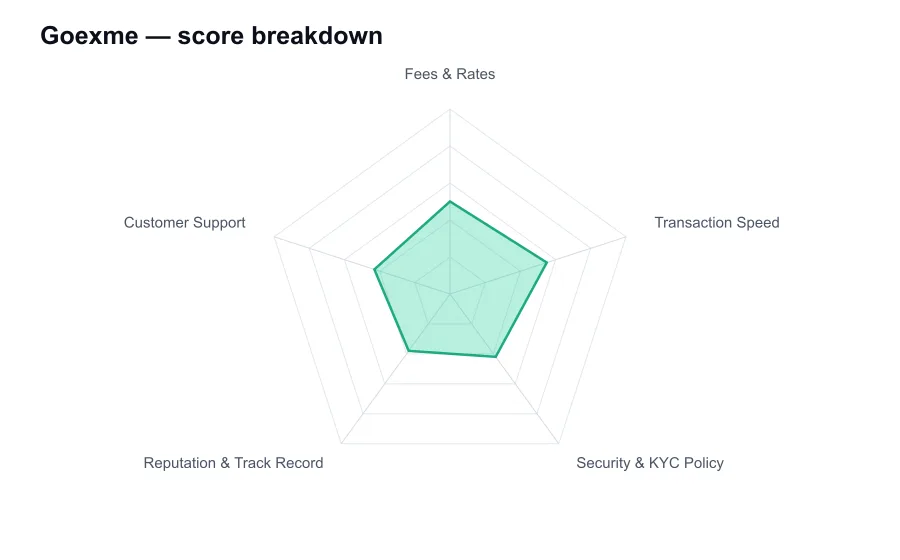
Goexme scores 4.6/10 overall in our independent review, measured against every other provider we've compared, strongest on Transaction Speed (5.5/10) and weakest on Reputation & Track Record (3.8/10).
Status: active (checked 2026-10-13T18:34:43.110Z)
Editorial independence: our scores and rankings are produced using the fixed criteria above and are not influenced by advertisers. This is an independent ranking site and is not operated by, or affiliated with, any provider we list.
Affiliate disclosure: some links on this page may earn us a commission at no extra cost to you. This does not affect our rankings.
| Best for | Simple no-account exchange concept, Potentially useful for small test swaps, Avoids a complex trading interface |
|---|---|
| Not for | Very limited public track record, No clearly established fee documentation, Sparse security and company transparency, Support performance is hard to verify |
What is Goexme?
Score Breakdown
| Criterion | Score | Note |
|---|---|---|
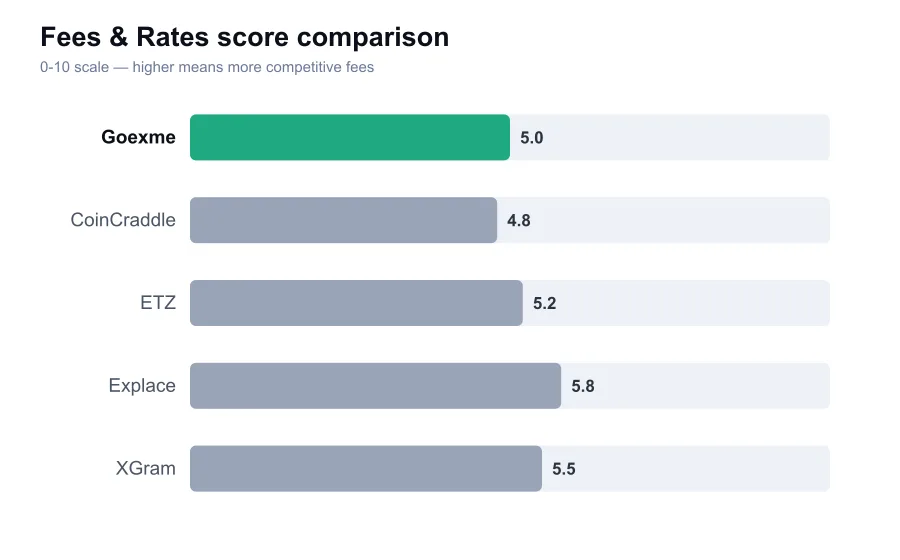
| Fees & Rates | 5.0 | Final quote matters, public fee detail is limited |
| Transaction Speed | 5.5 | No strong independent execution record |
| Security & KYC Policy | 4.2 | Sparse public security and operator information |
| Reputation & Track Record | 3.8 | Limited independently established track record |
| Customer Support | 4.3 | Support quality is difficult to verify publicly |
| Fact | Value | Source |
|---|---|---|
| Service model | Crypto instant exchange | - |
| Account model | No conventional trading account | - |
| Public fee disclosure | Limited independently verified detail | - |
| Public track record | Limited independently established history | - |
| Recommended transaction size | Small test swaps only | - |
Our Review
Goexme is a small crypto instant-exchange brand with far less public visibility than established services such as Godex, ChangeNOW, or LetsExchange. It appears to target the familiar no-account swap customer: select an asset pair, provide a destination address, and exchange crypto without using a full trading terminal. The problem is not that this model is unusual. The problem is that Goexme offers too little independently verifiable history for a reviewer to grant it much trust.
A low-profile provider can still be legitimate, of course. Many exchange aggregators operate quietly because their customers only need them for a few minutes at a time. But that also makes reputation difficult to assess. There is limited widely recognized third-party coverage, limited evidence of a long operational track record, and little public material about the company, team, or custody arrangements behind the service.
That weak transparency should shape the way a user evaluates every other claim. A homepage can display many coins, fast processing promises, and attractive rates. None of that tells you whether the operator can resolve a failed payout, how it sources liquidity, or whether it has enough operational depth to handle a chain outage. With a small instant exchanger, those are the questions that matter.
Pricing is difficult to score generously because Goexme does not have a broadly established, clearly documented fee schedule comparable to Godex's 0.5% public fee or FixedFloat's historic fixed and floating fee choices. The relevant cost is the final quoted output. A rate that looks cheap can include a spread, route through a liquidity provider, or change after deposit if the exchange uses a floating quote.
That does not make Goexme uniquely bad. Instant exchangers commonly earn through a combination of visible fees, liquidity spread, and blockchain costs. The difference is transparency. A serious provider makes it easy to understand which parts are fixed, which are estimated, and who bears the cost if the market moves while the deposit confirms. Goexme does not have a strong enough public record on that point to deserve a high fee score.
Speed claims must also be treated cautiously. Any service can process a fast-chain asset quickly if its liquidity partner is available and the deposit arrives cleanly. Bitcoin, Ethereum, and token transfers on congested networks introduce confirmation and gas delays that no website can eliminate. For Goexme specifically, there is insufficient independent evidence to say that its typical execution speed consistently matches better-known competitors.
The service appears to follow the usual instant-exchange sequence, where the customer sends funds first and receives the converted asset later. This is not a decentralized atomic swap. It is a mediated transaction. The user therefore faces an interval of counterparty risk, even if the site does not maintain an account balance after the order is complete.
No prominent account-registration requirement may appeal to privacy-conscious users. Yet a no-login interface should never be read as an unconditional no-KYC promise. Transaction monitoring, sanctions screening, and anti-money-laundering reviews can happen at many services, often through their liquidity partners. A user who needs certainty about compliance treatment should choose a regulated exchange and complete verification before moving funds.
Security is Goexme's weakest area, mostly because there is so little evidence to inspect. I cannot point to mature public security documentation, a clear independent audit record, a detailed incident archive, or well-developed account protections. Since an instant exchange does not ask users to store funds long-term, the key question is whether its order-handling infrastructure and payout process can be trusted. Publicly available information does not support a confident answer.
Support is similarly hard to praise. Small providers can give quick personal replies, sometimes faster than giant exchanges. They can also disappear into a contact form when a transaction becomes complicated. Before using Goexme, I would test the support channel with a simple pre-sale question and judge the answer by its specificity. A vague promise to resolve issues is not enough when a crypto transfer is irreversible.
The right comparison is not Goexme versus a bank. It is Goexme versus other instant exchangers that offer the same convenience while providing more proof of sustained operation. LetsExchange has stronger public integrations and broader visibility. Godex has a clearer public fee proposition. ChangeNOW has a much larger public footprint. Goexme needs a compelling execution advantage to overcome its information deficit, and I do not see one.
That makes deposit discipline essential. Never send a large amount to a lesser-known exchanger as a first interaction. Check the domain letter by letter, verify the destination chain, avoid copying wallet addresses through untrusted software, and use a small test transaction. If the test fails, do not compound the problem by sending more while waiting for support.
I would also avoid using Goexme for a deadline-sensitive payment. If you need an exact USDT amount on a particular network by a certain hour, use a service with more visible liquidity operations or a major exchange where you control the trade and withdrawal. An unproven intermediary creates too many variables, including whether the quote remains valid and whether anyone can intervene if it does not.
Goexme may work for a small experimental swap, but that is the ceiling of my recommendation. Its apparent no-account convenience is not enough to outweigh the lack of independently established reputation, pricing clarity, and support evidence. A provider earns trust over years and through transparent handling of problems. Goexme has not yet provided enough material to clear that bar.
Pros & Cons
| Pros | Cons |
|---|---|
| Simple no-account exchange concept | - |
| Potentially useful for small test swaps | - |
| Avoids a complex trading interface | - |
How Goexme Works
- Choose the asset pair and amount
- Enter a wallet address for the asset you want to receive
- Review the displayed order details
- Send funds to the generated deposit address
- Retain the order ID and monitor the payout
KYC
| Requirement | optional |
|---|---|
| Notes | The apparent no-account flow does not establish an unconditional no-KYC policy. Users should assume a transaction can be reviewed if compliance systems or liquidity partners flag it. |
How to Use Goexme Safely
- Use only a small test amount on a first order
- Compare the live quote with established competitors
- Verify the domain and destination network carefully
- Keep the order ID and on-chain transaction hash
- Do not use it for deadline-sensitive or large transfers
FAQ
Why is Goexme's reputation score low?
The concern is limited independently established operational history and sparse public information about the operator, security controls, and dispute handling. That makes it hard to assess counterparty risk with confidence.
Should I use Goexme for a large swap?
No. The review recommends only a small test transaction, if any. Large trades need a provider with a stronger public record, deeper liquidity evidence, and clearer escalation options.
How can I check a Goexme quote safely?
Compare the final amount shown for the identical pair and network against at least two established instant exchangers. Include network fees and confirm whether the quote is fixed or can change after deposit.
What should I keep after creating an order?
Save the order ID, deposit address, destination address, amount, timestamp, and blockchain transaction hash. Those details are essential if a payout is delayed or support needs to trace the order.
Can a no-account swap still be reviewed?
Yes. A service can use transaction monitoring or rely on liquidity partners that conduct compliance screening. No visible account-registration step does not guarantee that a transfer will never be held for review.
Is Goexme a decentralized exchange?
No evidence suggests an on-chain order-book or automated-market-maker model. Its apparent flow is that of an instant exchange, where funds are sent to a generated address and a provider arranges the payout.