MoneroBridge
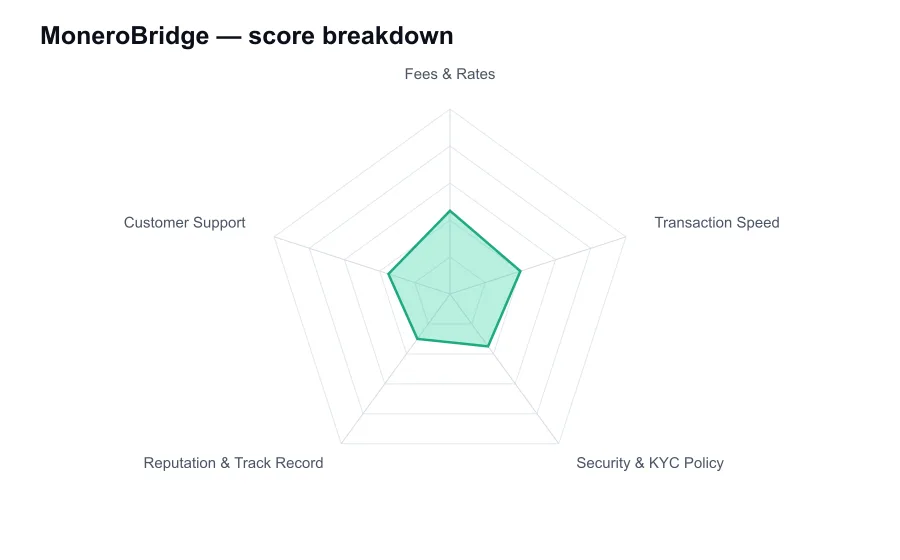
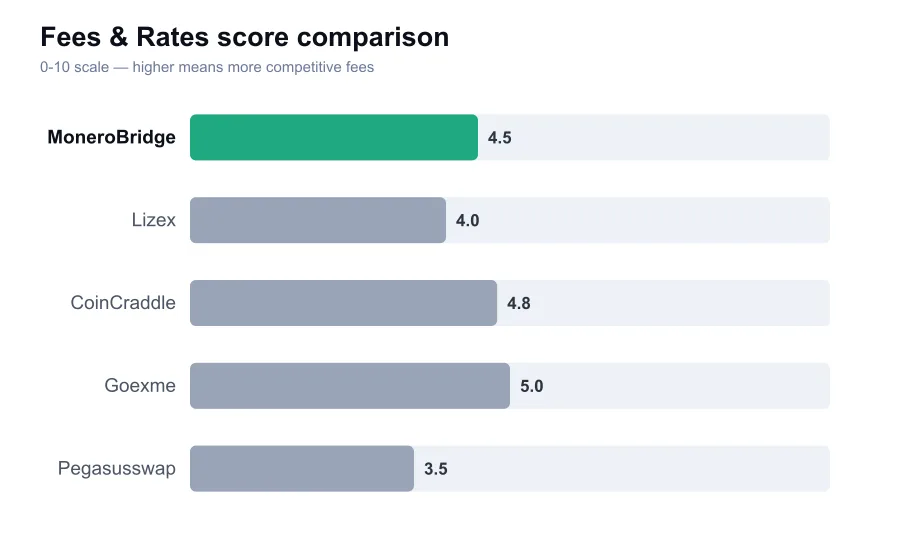
MoneroBridge scores 3.8/10 overall in our independent review, measured against every other provider we've compared, strongest on Fees & Rates (4.5/10) and weakest on Reputation & Track Record (3.0/10).
Status: active (checked 2026-10-13T18:38:51.235Z)
Editorial independence: our scores and rankings are produced using the fixed criteria above and are not influenced by advertisers. This is an independent ranking site and is not operated by, or affiliated with, any provider we list.
Affiliate disclosure: some links on this page may earn us a commission at no extra cost to you. This does not affect our rankings.
| Best for | Clear Monero-focused use case, Convenient wallet-to-wallet swap concept, Potentially useful for small XMR conversions |
|---|---|
| Not for | Limited independently verifiable reputation, Fee components are not clearly established, KYC hold policy needs stronger disclosure, Not appropriate for large first-time transfers |
What is MoneroBridge?
Score Breakdown
| Criterion | Score | Note |
|---|---|---|
| Fees & Rates | 4.5 | Assess the final XMR quote, not an unverified headline fee. |
| Transaction Speed | 4.0 | Monero confirmations and sparse public timing data add uncertainty. |
| Security & KYC Policy | 3.5 | XMR swaps need clearer hold and verification procedures. |
| Reputation & Track Record | 3.0 | Limited independently verifiable long-term service record. |
| Customer Support | 3.5 | Test support before trusting it with a live XMR transfer. |
| Fact | Value | Source |
|---|---|---|
| Service model | Instant crypto exchange | - |
| Primary niche | Monero conversion | - |
| Custody model | Transaction-based execution | - |
| Pricing method | Quoted exchange payout | - |
| Public track record | Limited independent evidence | - |
Our Review
MoneroBridge is positioned around a straightforward proposition: helping users move between Monero and other crypto assets through a swap-style service. That focus gives it a clear audience, particularly people who want XMR without opening a full exchange account. It also puts the provider under a higher standard of scrutiny than a generic coin converter.
Monero is treated cautiously by many centralized exchanges, payment companies, and compliance teams because its blockchain obscures transaction details. A service handling XMR therefore needs unusually clear rules. Users must know whether an order can be screened, what happens to a deposit during a review, and whether a payout can be returned if the service refuses to complete a swap.
The main weakness in assessing MoneroBridge is the limited amount of independently verifiable corporate and operational information. I could not establish the sort of mature public record available for long-running exchanges or larger instant-swap providers. For a service that may receive privacy-sensitive transfers, that is a serious limitation rather than a cosmetic one.
Its narrow Monero-oriented identity is potentially useful. A specialist can offer a cleaner XMR conversion path than a broad exchange that treats Monero as an afterthought. But specialization only counts if liquidity, rate calculation, wallet operations, and support are reliable. A Monero label does not make a service safer by itself.
Fee assessment needs discipline here. The amount displayed to receive is the number that matters, after the service spread, liquidity cost, and network fees have been absorbed. If MoneroBridge does not clearly split those components, users should not describe its rate as cheap simply because the interface shows no large headline charge.
Compare the quote against at least two alternatives just before creating an order. Monero liquidity can differ significantly between services, especially during volatile periods. A provider can look competitive on a small conversion and become expensive on a larger one because the effective spread widens with order size.
Speed depends partly on Monero's confirmation process and partly on the destination network. A conversion from XMR into a busy Bitcoin or Ethereum route can take longer than users expect. The key question is not whether every transfer settles in minutes. It is whether the provider communicates the order state accurately when network conditions change.
I found insufficient public evidence to award MoneroBridge a strong speed score. That does not mean every order is slow. It means prospective customers cannot easily verify normal completion times, delayed-order treatment, or the provider's historical response when a blockchain node, liquidity partner, or outgoing wallet encounters trouble.
The phrase non-custodial is often used loosely in this sector. During an active exchange, a swap service still controls the deposited funds and the execution process. MoneroBridge may reduce the need to leave a standing balance on a platform, which is positive, but users should not confuse a transaction-based flow with a decentralized protocol.
KYC is the point most likely to disappoint users who arrive because they want Monero. A provider can advertise a light onboarding process yet reserve the right to request source-of-funds information after receiving a deposit. That policy is not unusual, but it must be visible before the user commits funds, not disclosed in a support conversation after a hold.
Reputation is currently the larger concern. A credible XMR service needs more than a functioning website. It needs long-term reports from real users, prompt public replies to complaints, identifiable operational responsibility, and a coherent policy for disputed transactions. MoneroBridge does not have enough independently verifiable material for me to put it in that category.
Support should be tested before a transfer, not after one. Ask a specific pre-sale question about an XMR deposit with a payment ID issue, a delayed outgoing transaction, or an incorrect destination network. The quality and speed of that reply will reveal more than a generic promise of around-the-clock assistance.
For a small XMR conversion, MoneroBridge may be an option if its live quote is demonstrably competitive and the user accepts the extra counterparty risk. It is not the service I would choose for a first large Monero purchase, a deadline-sensitive payment, or funds whose origin will be difficult to document if questioned.
My recommendation is cautious and fairly negative. MoneroBridge serves an understandable niche, yet the niche makes transparency more important, not less. Until the service builds a stronger public record and explains its fee, security, and review procedures in more detail, established alternatives with visible operational histories deserve preference.
Pros & Cons
| Pros | Cons |
|---|---|
| Clear Monero-focused use case | - |
| Convenient wallet-to-wallet swap concept | - |
| Potentially useful for small XMR conversions | - |
How MoneroBridge Works
- Select XMR and the asset you want to exchange
- Enter the receiving wallet address on the correct network
- Review the quoted output and order details
- Send XMR or the selected deposit asset to the order address
- Wait for confirmations and the outgoing payout
KYC
| Requirement | tiered |
|---|---|
| Notes | Do not treat a simplified swap flow as a guarantee of no verification. A provider may pause an order under risk controls after receiving the deposit. |
Supported Assets
| Notable Coins | Monero, Bitcoin, Ethereum |
|---|
How to Use MoneroBridge Safely
- Send a small XMR test order before any large conversion
- Check the destination asset network before confirming
- Compare final receive amounts across several providers
- Keep the order ID and both transaction hashes
- Do not send additional funds to a new address without verifying it through official support
FAQ
Is MoneroBridge a decentralized exchange?
No. It is best treated as an instant exchange service. During an active order, the provider receives the deposit and controls execution of the payout.
Why can an XMR swap take longer than a token swap?
The deposit must receive Monero confirmations, then the outgoing asset must be sourced and confirmed on its own network. Congestion can add time.
Does using MoneroBridge guarantee no KYC?
No. The review rates security at 3.5 out of 10 partly because a clear, independently verifiable verification and hold policy is not available.
How should I compare MoneroBridge pricing?
Use the final amount you will receive. Compare the same XMR amount and destination network with at least two alternative providers at the same moment.
What should I test with support first?
Ask how a delayed Monero deposit, a risk review, or a wrong destination network is handled. Save the response before sending a live order.