Explace
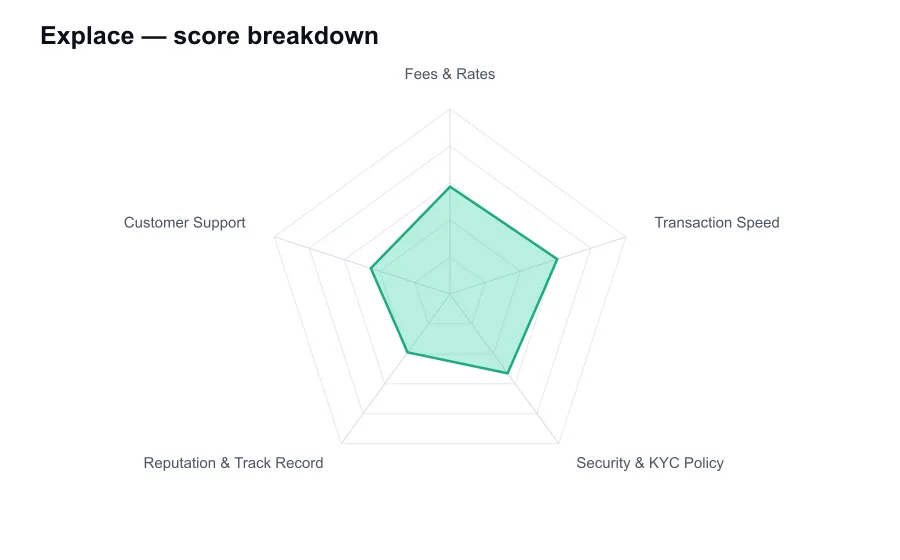
Explace scores 5.2/10 overall in our independent review, measured against every other provider we've compared, strongest on Transaction Speed (6.1/10) and weakest on Reputation & Track Record (3.9/10).
Status: active (checked 2026-10-13T18:32:28.038Z)
Editorial independence: our scores and rankings are produced using the fixed criteria above and are not influenced by advertisers. This is an independent ranking site and is not operated by, or affiliated with, any provider we list.
Affiliate disclosure: some links on this page may earn us a commission at no extra cost to you. This does not affect our rankings.
| Best for | Simple wallet-to-wallet swap format, No need for a standing exchange balance, Can be useful for a small quote comparison, Suitable for a cautious test transaction |
|---|---|
| Not for | Limited public pricing transparency, Thin independently verifiable reputation, Not appropriate for large or urgent transfers, Support performance in exceptions is hard to assess |
What is Explace?
Score Breakdown
| Criterion | Score | Note |
|---|---|---|
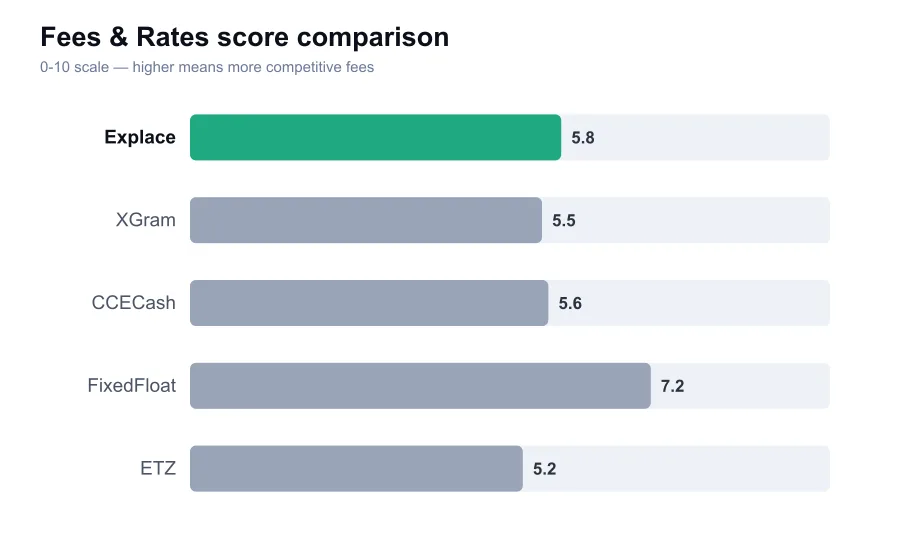
| Fees & Rates | 5.8 | Judge by final payout, public fee transparency is limited |
| Transaction Speed | 6.1 | Routine swaps may be quick, consistency is less documented |
| Security & KYC Policy | 5.3 | Transaction-based flow, but limited public operating detail |
| Reputation & Track Record | 3.9 | Small public footprint and limited long-term evidence |
| Customer Support | 4.5 | Verify support responsiveness before funding an order |
| Fact | Value | Source |
|---|---|---|
| Service model | Instant cryptocurrency exchange | - |
| Custody model | Transaction-based swap flow | - |
| Customer balances | Not designed for long-term storage | - |
| Pricing method | Quote shown before payment | - |
| Recommended use | Small, non-urgent test swaps | - |
Our Review
Explace is an instant cryptocurrency exchange service built for simple one-off swaps rather than active trading. Its core pitch is the familiar one used across this part of crypto: no long account-opening process, no need to keep a balance on the site, and a direct route from one wallet to another. That can be useful. It can also encourage users to move too quickly. Explace is a smaller name than the best-known instant exchangers, so the right way to approach it is with a focus on quote quality, transaction records, and limited exposure.
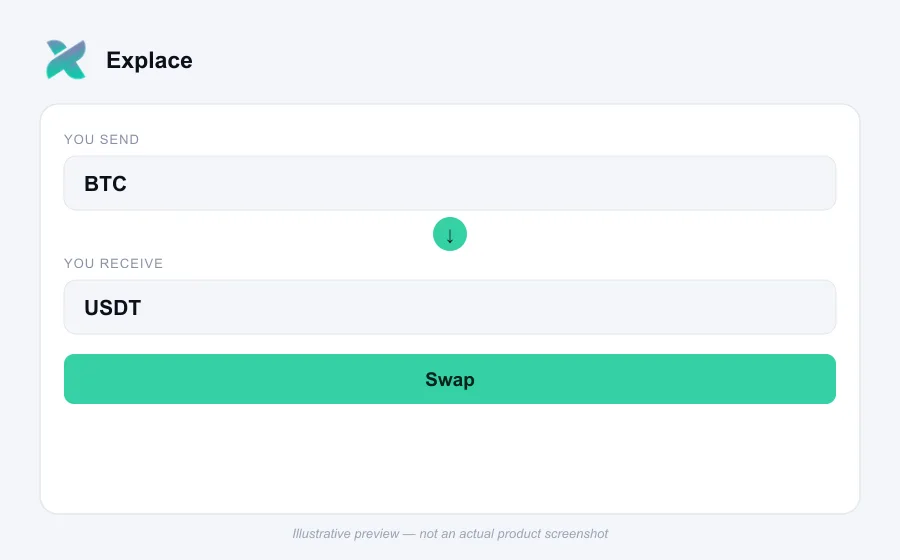
A customer using Explace does not get an order book, a trading chart, margin tools, or the broad account controls associated with a centralized exchange. Instead, the service generates a transaction-specific address after you choose the input and output assets. Your deposit is converted through the service's operational and liquidity infrastructure, then the payout is sent to your chosen wallet. This is convenient for self-custody users. It is also a counterparty transaction, even if the provider describes itself as non-custodial.
Fees are the first point where consumers need to be more demanding than the marketing. A swap site can present a competitive rate while incorporating its compensation in the conversion spread rather than displaying a clean commission line. Explace should be judged by the exact quantity that will arrive in your destination wallet. Compare that number with at least two alternatives. For major pairs, check a centralized exchange as well. For smaller tokens, compare several instant-exchange quotes because liquidity routes can vary wildly from one provider to another.
The absence of a clearly established, widely cited public fee schedule makes it hard to give Explace high marks on pricing transparency. That does not mean every quote is expensive. It means the user has to perform the work that a transparent platform would have done for them. If the final quote is good, a small conversion can be sensible. If the quote is meaningfully worse than competitors, there is no special reason to pay extra merely because the order form is simple.
Speed depends heavily on the deposited asset and chain. A stablecoin sent through a fast, low-cost network can be recognized and exchanged quickly. Bitcoin needs confirmations. Ethereum may be delayed by congestion or an insufficient gas fee. These are normal blockchain constraints, but a good instant exchanger should make its status updates clear once the deposit is received. Explace may be able to process a routine swap promptly, yet there is less independent evidence available about performance consistency during busy periods or unusual transaction cases.
That uncertainty changes the recommendation. Explace is not the provider I would choose for a deadline-sensitive conversion, a collateral top-up, or a large transfer where every minute matters. An established major exchange gives you far better visibility over whether an order has executed. A larger instant exchanger usually gives you more public data points about how it handles delayed payouts. With Explace, users should treat the quoted completion time as an estimate rather than a promise.
The non-custodial framing is helpful but needs careful interpretation. Explace does not appear designed for long-term customer balances in the way an exchange wallet is. The user supplies a receiving address, which is good practice. Yet once you send the deposit, the service controls the process until it broadcasts the payout. If its systems, a liquidity provider, or a compliance review pause the order, you do not have unilateral access to the deposited funds. That is the central tradeoff of every instant exchanger.
KYC policy should also be read with care. A service can allow orders without a visible signup form while retaining the right to seek verification under anti-money-laundering checks. That is common and often necessary for providers that touch third-party liquidity. Prospective customers should never build a transaction plan around the assumption that a no-registration flow means unconditional anonymity. If you cannot provide source-of-funds information if asked, an instant exchanger is a poor tool for moving a material amount.
Explace's limited public footprint is its biggest drawback. Reputation in crypto is earned through time, transparent business information, visible responses to user problems, and evidence that the service can survive difficult market conditions. A smaller provider has less of all of that available for scrutiny. This does not establish bad faith. It does establish uncertainty, and uncertainty should lower the amount you are willing to trust to the platform. Crypto transfers are irreversible, so a lack of evidence is itself relevant evidence for risk management.
Support is especially important for a newer or smaller service. A routine transaction requires little human help. A deposit with the wrong tag, an unsupported network, a changed receiving address, or a compliance query is different. Before sending funds to Explace, find the current support route and ask a specific question about your intended pair or network. If you cannot get a clear answer before funding an order, do not expect a better experience after something goes wrong. That may sound severe, but it is sensible due diligence.
There are technical details that can cause trouble even in a perfectly functioning exchange. Some assets require destination tags or memos. Stablecoins share names across chains. Wallet software may display a token while hiding the network distinction from a casual user. Explace cannot safely guess what you intended. Confirm the sender's network, the Explace deposit network, and the receiving wallet's supported network before you approve the transfer. The cheapest route is only cheap if the recipient can actually receive it.
For someone determined to try Explace, the sensible method is a small first order. Use an asset with uncomplicated transfer mechanics, such as a common coin on its native chain. Document the quoted payout, order ID, payment deadline, deposit address, and transaction hash. Do not send additional funds to the same address unless support explicitly instructs you to do so. Once the initial swap has completed, you have some direct evidence about the service, though one successful small order is still not proof that a large order will behave the same way.
Explace can have value as a quote source and occasional convenience tool. The instant-exchange format is useful for users who do not want to deposit into a centralized exchange for every conversion. But the thin public record means Explace has not earned a premium level of trust. Better-known rivals may charge a similar amount while offering more years of operating evidence and more user reports to assess.
My take is cautious rather than hostile. I would not call Explace unusable, but I would not recommend it ahead of EasyBit or Exolix without a clearly superior live quote and a successful test transaction. Its basic model is sensible, while its reputation and transparency remain underdeveloped. Keep the order small, verify every network detail, and use a provider with a stronger public record when the funds are significant. In crypto, the easiest swap screen is rarely the most important part of the decision.
Pros & Cons
| Pros | Cons |
|---|---|
| Simple wallet-to-wallet swap format | - |
| No need for a standing exchange balance | - |
| Can be useful for a small quote comparison | - |
| Suitable for a cautious test transaction | - |
How Explace Works
- Choose the cryptoasset pair and amount
- Check the displayed payout and network details
- Provide the wallet address that should receive the output
- Send the requested deposit to the generated address
- Track the order until the converted funds reach your wallet
KYC
| Requirement | optional |
|---|---|
| Notes | A basic instant swap may not require account registration, but customers should assume verification can be requested if an order is flagged by AML or fraud controls. |
How to Use Explace Safely
- Make your first Explace order a small test transfer
- Compare the final payout with at least two alternatives
- Confirm token and network at the sending and receiving wallets
- Save the order details and blockchain transaction hash
- Avoid using the service for a deadline-sensitive transaction
FAQ
Should I use Explace for a large transaction?
No. Explace receives a 3.9 out of 10 reputation score here because its independently verifiable public track record is limited. A small test transaction is the safer approach.
Does Explace require KYC?
Do not treat a simple no-registration flow as a guarantee of no KYC. Instant exchange providers can request documents if an order is subject to AML or risk review.
How can I tell whether an Explace quote is competitive?
Compare the exact amount you will receive with at least two instant exchangers and, for liquid pairs, a major centralized exchange. The final payout is more meaningful than any headline fee.
Why can an Explace swap take longer than expected?
The deposit may still be awaiting blockchain confirmations, the network may be congested, or the order may need manual review. Bitcoin and Ethereum transfers can be slower than low-cost network transfers.
Can I send the same stablecoin ticker on any network?
No. USDT and USDC on Ethereum, Tron, Solana, Polygon, or other chains are different transfer routes. Use only the exact deposit network displayed for the order.
What should I do before contacting Explace support?
Collect the order ID, transaction hash, sent amount, asset, blockchain network, deposit address, and receiving address. These details let support locate a transaction much faster.