CoinCraddle
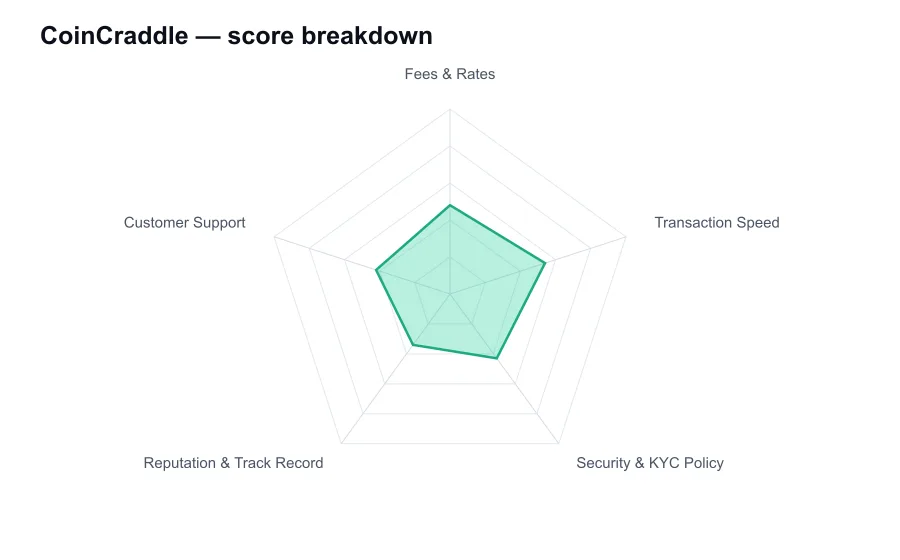
CoinCraddle scores 4.5/10 overall in our independent review, measured against every other provider we've compared, strongest on Transaction Speed (5.4/10) and weakest on Reputation & Track Record (3.4/10).
Status: active (checked 2026-10-13T18:29:54.052Z)
Editorial independence: our scores and rankings are produced using the fixed criteria above and are not influenced by advertisers. This is an independent ranking site and is not operated by, or affiliated with, any provider we list.
Affiliate disclosure: some links on this page may earn us a commission at no extra cost to you. This does not affect our rankings.
| Best for | Simple wallet-to-wallet exchange model, No standing trading balance implied, Can be compared as an alternative live quote, Suitable for very small test transactions |
|---|---|
| Not for | Weak public track record, Limited independent information about operations, Fee composition is not clearly verifiable, Not suitable for large or urgent transfers |
What is CoinCraddle?
Score Breakdown
| Criterion | Score | Note |
|---|---|---|
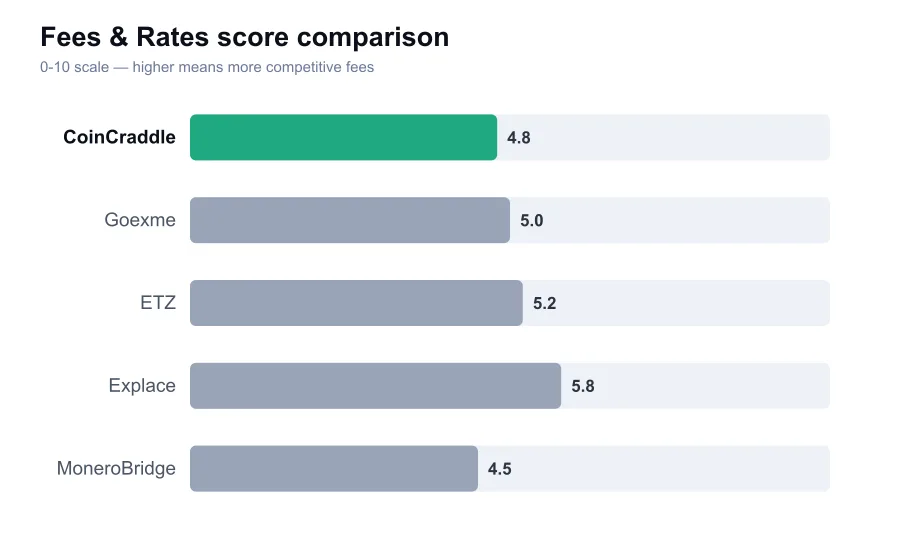
| Fees & Rates | 4.8 | Final quotes are easier to see than full cost components |
| Transaction Speed | 5.4 | Blockchain and liquidity conditions determine completion time |
| Security & KYC Policy | 4.3 | Limited public evidence for assessing operational safeguards |
| Reputation & Track Record | 3.4 | Very limited independently established track record |
| Customer Support | 4.2 | Support quality is hard to verify from public evidence |
| Fact | Value | Source |
|---|---|---|
| Service model | Instant crypto exchange | Source |
| Transaction flow | Deposit and payout order | Source |
| Account model | Wallet-to-wallet exchange flow | Source |
| Rate presentation | Quoted output amount | Source |
| Public track record | Limited independently verifiable history | - |
Our Review
CoinCraddle presents itself as an instant cryptocurrency exchange service for users who want to move between cryptoassets without the friction of a standard centralized exchange account. It belongs to a crowded market where clean interfaces are easy to build and where credibility is much harder to establish. Compared with names such as ChangeNOW and ChangeHero, CoinCraddle has a very limited public profile.
That lack of visibility shapes this review more than any feature listed on a landing page. A crypto exchange service earns trust through years of observable transactions, clear policies, responsive handling of exceptions, independent feedback, and a public company record that users can evaluate. CoinCraddle does not have the same body of externally verifiable evidence as the category leaders.
The intended flow is familiar. A user selects a cryptocurrency pair, enters an amount and payout address, sends a deposit to a generated address, and waits for the service to deliver the converted asset. This is a convenient structure for someone who already holds crypto in a private wallet. It also creates a period in which the user has handed funds to a counterparty without the protections of a regulated brokerage account.
I would not call CoinCraddle a scam without hard evidence. That would be irresponsible. But I also cannot recommend it with the confidence appropriate for a well-established provider. The responsible position is caution. If a service has little independently documented history, the burden is on the user to limit exposure, verify every detail, and avoid treating a polished site as proof of reliability.
Fees are difficult to assess precisely because public pricing detail is limited. Instant exchange services commonly quote a single estimated output rather than itemizing every component of the cost. CoinCraddle appears to follow that general model. A user may see a rate, but not necessarily a clear separation between platform margin, market spread, liquidity-provider pricing, and blockchain network fees.
That makes quote comparison mandatory. Enter the same amount and pair at CoinCraddle, ChangeNOW, ChangeHero, and a liquid exchange if available to you. Compare the number of coins you will receive after all deductions. Never assume a service is cheap because it advertises a low or zero fee. A wide conversion spread can cost more than a clearly disclosed trading fee.
Transaction speed is similarly conditional. A website can process an order quickly only after it receives a valid deposit with sufficient confirmations and finds liquidity for the requested pair. Transfers on Bitcoin and Ethereum may be delayed by blockchain congestion. Less common assets can face slower partner execution. A promise of an “instant” exchange should be understood as a target for ordinary conditions, not a guarantee.
CoinCraddle's smaller profile makes operational exceptions the central concern. What happens if the output transaction fails, the deposit is underpaid, a token is sent on the wrong chain, or a compliance system flags an address? Large providers at least have extensive public user history that can help a prospective customer gauge their response. With CoinCraddle, there is less evidence to work from.
Security claims need the same skeptical treatment. A wallet-to-wallet exchange can reduce the danger of leaving an ongoing balance at a platform, because the output is sent to a personal address. Yet the service still receives the deposit during the conversion. Non-custodial should describe the absence of a long-term customer balance, not be mistaken for a guarantee that no counterparty risk exists.
KYC policy is especially important. Many instant exchangers permit ordinary transactions without a standard account verification process, while reserving the right to request documents under anti-money-laundering procedures. Users should assume CoinCraddle can apply the same kind of risk review unless its terms clearly and credibly state otherwise. Do not send funds if a potential document request would create a serious problem.
A prospective customer should look beyond the marketing page. Search for a legal entity, usable terms, privacy policy, support address, transaction-status process, and clear explanation of how compliance holds are resolved. Confirm that the official domain uses secure HTTPS, then avoid links from social media advertisements or unsolicited messages. Clone sites are a recurring problem across the instant-exchange sector.
Customer support may be adequate for routine questions, but that cannot be inferred from the existence of a chat bubble. The important test is whether the service can provide a prompt, specific response with an order ID and transaction hash when something goes wrong. Before making a deposit, find the support route, read the terms, and make sure you can identify where an unresolved dispute would be taken.
CoinCraddle may be useful as an experimental route for a very small conversion, particularly if it presents a genuinely stronger live quote on a specific pair. Even then, I would test with an amount I could tolerate losing or having delayed. There is no sensible reason to make a large first transaction through a little-documented service when mature alternatives exist.
My final assessment is blunt. CoinCraddle has the basic shape of an instant exchange, but it has not demonstrated enough public track record to deserve the trust placed in larger providers. Until it develops a stronger independently visible reputation and clearer operational documentation, it belongs in the high-caution category. Small test swaps only, no urgent transfers, and no large amount that would be painful to have held.
Pros & Cons
| Pros | Cons |
|---|---|
| Simple wallet-to-wallet exchange model | - |
| No standing trading balance implied | - |
| Can be compared as an alternative live quote | - |
| Suitable for very small test transactions | - |
How CoinCraddle Works
- Select the cryptocurrency pair and amount
- Enter the destination wallet address
- Review the quoted output and network information
- Send the deposit to the order address
- Use the order details and transaction hash to monitor completion
KYC
| Requirement | optional |
|---|---|
| Notes | A standard account-based verification requirement is not clearly established, but users should assume that a risk or AML review could require documents. |
How to Use CoinCraddle Safely
- Use only a small test amount on a first order
- Type the official domain directly rather than following ads
- Check the network as well as the token symbol
- Do not send funds needed for an urgent payment
- Save all order details before making a deposit
- Compare the received amount with established alternatives
FAQ
Is CoinCraddle a full centralized exchange?
CoinCraddle appears to operate as an instant exchange service, using a transaction-by-transaction wallet-to-wallet flow rather than a conventional spot-trading account with an ongoing balance.
Should I use CoinCraddle for a large first swap?
No. CoinCraddle has a limited publicly established track record, so a small test transaction is far safer than sending a large amount on a first use.
Can the displayed CoinCraddle quote change?
It can, particularly if the order uses a floating rate. Market movement, confirmation delays, and liquidity conditions can affect the final payout.
What should I check before depositing to CoinCraddle?
Verify the domain, token ticker, blockchain network, receiving address, minimum amount, and order details. Save a screenshot and the deposit transaction hash.
Why might an instant exchange take longer than expected?
The service must wait for blockchain confirmations and then source the conversion. Bitcoin congestion, Ethereum gas conditions, and thin liquidity can all slow the process.
Could CoinCraddle request verification documents?
Users should assume risk-based compliance checks are possible unless the provider's current terms clearly state otherwise. Instant exchange services can pause transactions for AML review.