Swapter
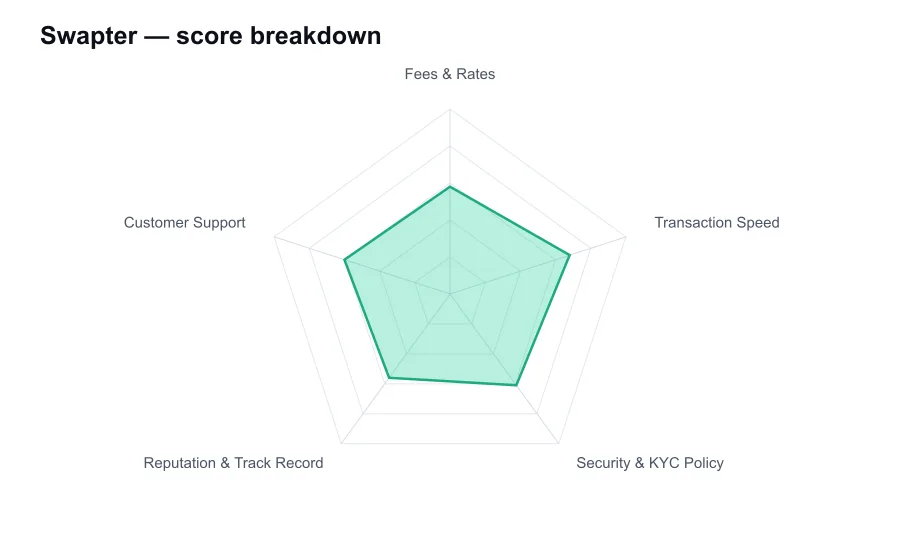
Swapter scores 6.1/10 overall in our independent review, measured against every other provider we've compared, strongest on Transaction Speed (6.8/10) and weakest on Reputation & Track Record (5.6/10).
Status: active (checked 2026-10-13T18:41:03.761Z)
Editorial independence: our scores and rankings are produced using the fixed criteria above and are not influenced by advertisers. This is an independent ranking site and is not operated by, or affiliated with, any provider we list.
Affiliate disclosure: some links on this page may earn us a commission at no extra cost to you. This does not affect our rankings.
| Best for | Simple wallet-to-wallet swap flow, No standing exchange balance, Useful as a quote comparison option, Account-light standard experience |
|---|---|
| Not for | Limited public track record versus major rivals, No clear universal fee schedule, Less independent information on controls and operations, Not ideal for large first-time transfers |
What is Swapter?
Score Breakdown
| Criterion | Score | Note |
|---|---|---|
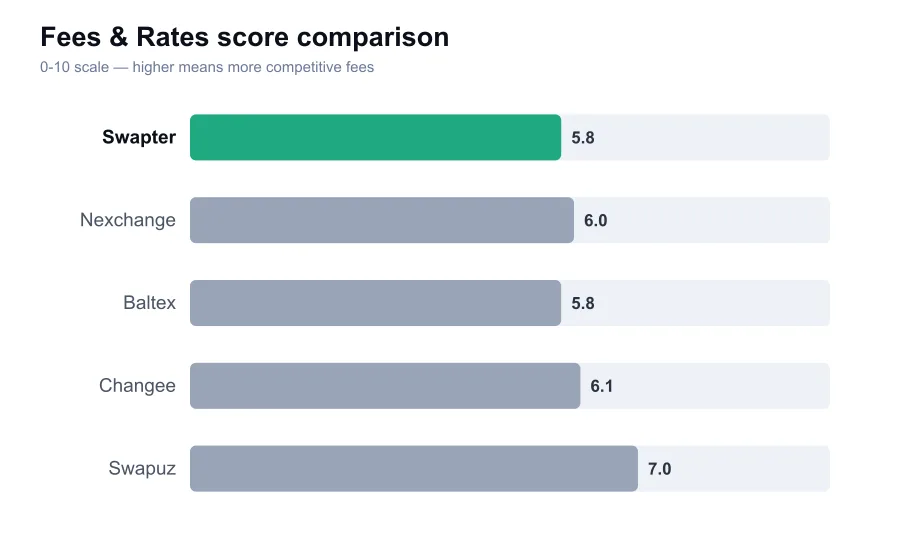
| Fees & Rates | 5.8 | Quote-based pricing lacks a clearly published universal fee. |
| Transaction Speed | 6.8 | Execution depends on confirmations, liquidity and output network conditions. |
| Security & KYC Policy | 6.1 | Short-duration custody helps, but public control detail is limited. |
| Reputation & Track Record | 5.6 | Smaller public footprint than leading instant exchangers. |
| Customer Support | 6.0 | Support exists, but its handling of difficult cases is less documented. |
Our Review
Swapter is a smaller instant crypto exchange service focused on simple conversions between digital assets. Like Quickex, SimpleSwap and StealthEX, it is not an order-book trading platform. Its role is to take an input cryptocurrency, route the conversion through its execution infrastructure or partners, and deliver the requested asset to the receiving address supplied by the customer.
That approach has a clear use case. A wallet holder who wants to convert one coin into another without creating an account at a centralized exchange may prefer a one-time swap. The process is familiar: select the pair, provide a wallet address, send the deposit and wait for delivery. It is a practical model, but Swapter has less public history and less independent scrutiny than the biggest names in this category.
Pricing is the first place where that smaller profile matters. Swapter uses quoted conversion rates rather than a universal, prominently published maker and taker fee schedule. The displayed payout is therefore the meaningful cost measure. It can include market spread, blockchain network costs and compensation for the service or liquidity route. A user should never assume a quote is cheap merely because the interface does not show a line item called fee.
The lack of a plainly stated platform-wide percentage makes Swapter harder to evaluate than StealthEX, which publishes a 0.4% fixed-rate service fee for that product type. It also makes it less convenient to budget than using a spot exchange with a known trading fee. Swapter can still be useful if its final payout is strong for the pair you need, but that needs to be verified in real time against alternatives.
Its transaction speed should be judged with a little skepticism. Instant exchange refers to the user experience, not to an instant blockchain settlement guarantee. Swapter needs the incoming funds to confirm, then needs liquidity and the output network to function normally. A fast-chain transfer may complete quickly. A Bitcoin, Ethereum mainnet or congested token route can take substantially longer, especially if the source transaction was broadcast with a low network fee.
Smaller services often make a mistake by showing one generic time estimate for all assets. Users should focus on the source chain's confirmation conditions instead. If the deposit has not been recognized, the exchanger cannot complete the swap. If it has been recognized but the payout is delayed, the order details and transaction hash become essential. Swapter should be treated as a process to monitor, not a black box to forget after clicking confirm.
Swapter is presented as a non-custodial, account-light service. That is preferable to keeping an ongoing balance with a minor exchange. You retain your wallet keys before depositing and receive output into your own wallet after execution. But funds are still outside your control during the swap, so the security model is based on minimizing custody duration, not removing trust from the transaction.
The service's standard flow does not normally require a conventional exchange profile. That can be attractive to users who value privacy and dislike handing over documents for a small swap. Yet no-registration is not the same as no compliance. If Swapter or a partner identifies an AML concern, the transaction can be paused and additional information can be requested. Users should understand this before sending funds they need immediately.
This is a critical distinction for the security score. Swapter's short custody model is a positive, and a simple no-account flow reduces the risk of password compromise on a long-lived exchange profile. On the other hand, the company offers less public institutional transparency than larger regulated exchanges. There is limited widely available information on audits, reserves, corporate structure, incident response standards or the controls used by every liquidity partner.
Reputation is Swapter's weakest category. That does not mean it is automatically unsafe or illegitimate. It means the service has a more limited independently documented history than brands such as SimpleSwap and StealthEX. A reviewer should not award trust simply because a site looks professional or because its quote is attractive. In crypto, established operational history and a pattern of resolved customer issues carry real value.
Support is therefore more important here than it would be on a fully self-custodied on-chain protocol. Swapter provides support channels for order questions, but a prospective user should test responsiveness with a basic question before placing a meaningful transaction. What matters is whether support can identify an order from its ID, explain confirmation status clearly, and provide a documented remedy if a destination address, minimum amount or network condition creates a problem.
For smaller swaps, Swapter can be perfectly reasonable. It is the type of service I would consider for a conversion where the amount is limited, the asset route is common and the destination wallet is already tested. I would not use it as my first choice for a large cross-chain stablecoin movement, a time-critical payment, or a transaction where a compliance hold would create financial trouble.
The operational basics matter more than usual. Confirm the ticker and chain, because assets such as USDT and USDC exist on several incompatible networks. Respect the displayed minimum. Do not send a random amount to a deposit address after an order has expired. Keep screenshots of the quote and save the transaction ID. These precautions are minor until something goes wrong, then they are the difference between a traceable support case and a vague complaint.
Swapter is best seen as a secondary instant-exchange option rather than a category leader. It may produce a useful quote for a particular pair, and that is enough for a small, informed user. The lower reputation score reflects the thinner public record and limited fee transparency, not a claim of misconduct. Compare it aggressively, start small, and use a better-established service or regulated exchange when the amount is too large to treat as an experiment.
Pros & Cons
| Pros | Cons |
|---|---|
| Simple wallet-to-wallet swap flow | - |
| No standing exchange balance | - |
| Useful as a quote comparison option | - |
| Account-light standard experience | - |
How Swapter Works
- Select the cryptocurrency pair and desired amount
- Enter a receiving wallet address on the correct network
- Review the quoted destination amount
- Send the input asset to the generated deposit address
- Monitor the order until the converted asset is delivered
KYC
| Requirement | optional |
|---|---|
| Notes | The standard service flow is account-light, but identity or transaction information may be requested if AML screening flags an order for review. |
Supported Assets
| Notable Coins | Bitcoin, Ethereum, Tether, USDC, Litecoin, XRP, TRON, Solana |
|---|
How to Use Swapter Safely
- Compare Swapter's final payout against at least two alternatives
- Use a small test transaction before a larger transfer
- Confirm the exact token network at both ends
- Respect the displayed minimum deposit amount
- Save the order ID, quote and transaction hash
FAQ
Does Swapter publish a flat exchange fee?
Swapter uses quote-based pricing rather than a clearly published universal percentage fee. Compare the final destination amount with another service before sending funds.
Does Swapter require KYC?
A standard instant-swap flow is generally account-light, but compliance checks can still occur if a transaction is flagged under AML procedures.
Why should I test Swapter with a small amount first?
Swapter has a smaller publicly documented track record than leading instant exchangers. A test confirms the selected token, network, wallet address and payout flow work as expected.
Can I treat an instant swap as immediate settlement?
No. Swapter must wait for the input transaction to meet confirmation requirements, then process the route and broadcast the payout. Network congestion can extend the process.
What details should I save for a delayed Swapter order?
Save the order ID, source transaction hash, selected asset pair, deposit amount and receiving address. These details let support identify the transaction.
What is the biggest network risk with stablecoin swaps?
USDT and USDC exist on multiple chains. Sending or receiving the correct ticker on the wrong network can lead to delay or loss, so verify the exact chain before confirming.